Buying guide
Choose pixel pitch for your LED video wall. Tape measure first.
Four questions decide the pitch: where the wall goes, how close people stand, what it will show and what you can spend. Here is how to answer each, with five worked examples.
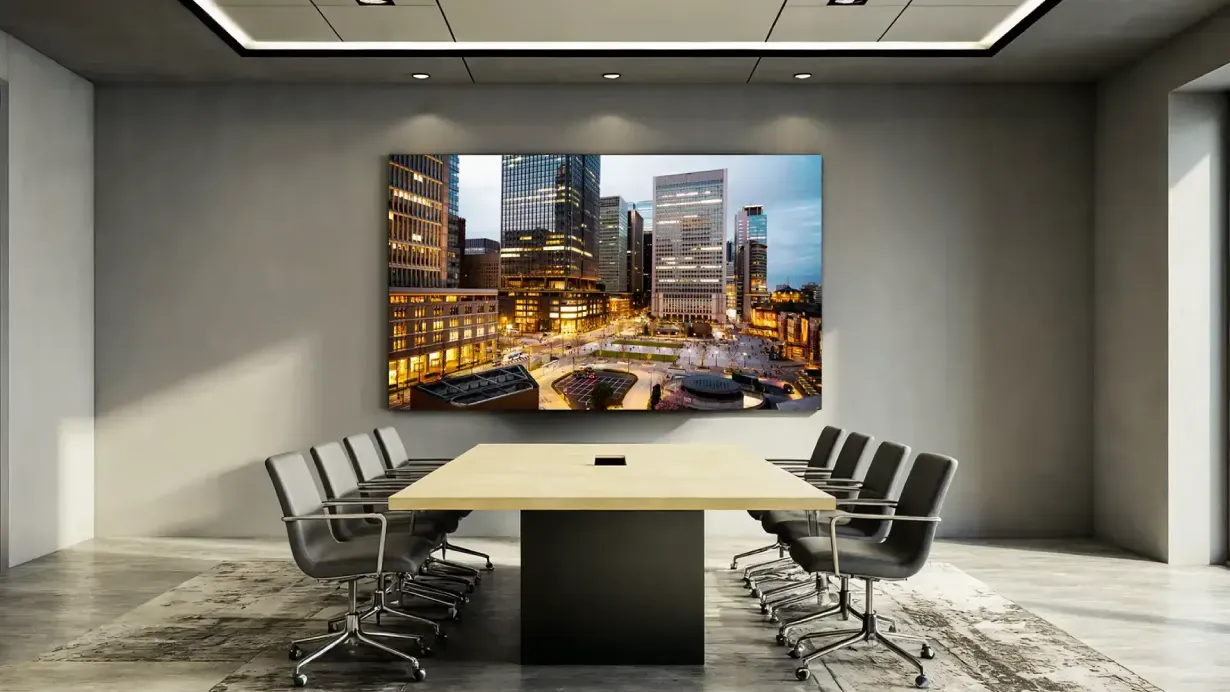
Most people choose pixel pitch backwards. They start from a spec sheet, or a wall they saw at a mall, and work towards their own room. Start from the room instead: where the wall goes, how close people stand, what it will show and what you can spend. The right pitch, and the price, fall out of those four answers.
The short version
- Measure from the wall to the nearest regular viewer. Choose a pitch whose number in millimetres is no bigger than that distance in metres.
- Most shops, restaurants, lobbies, temples and halls land on indoor P2.5, the most economical indoor pitch we build.
- Counters, boardrooms and text-heavy screens read from inside 2 m need P1.8 or finer.
- Outdoors: P4 for shopfronts read from the road, outdoor P2.5 for menus read up close, P5 or P6 for facades read from far away.
- On a fixed budget, a bigger wall at the right pitch beats a smaller wall at a finer one.
Question 1: indoors, outdoors, or behind glass?
This decides which half of the range you are shopping from. Outdoor modules are a different product: sealed to IP65 at the front, up to 4,500 nits for Bengaluru daylight, with automatic dimming after dark. Indoor modules cannot go outside, and outdoor modules are far too bright for a room.
The in-between case catches people out. A wall inside a glass shopfront, facing the street, is not an indoor wall. Daylight and reflections wash out a normal indoor panel, so that position needs an outdoor-grade panel, up to 4,500 nits; our guide to LED wall brightness explains why.
Question 2: how close will the nearest person stand?
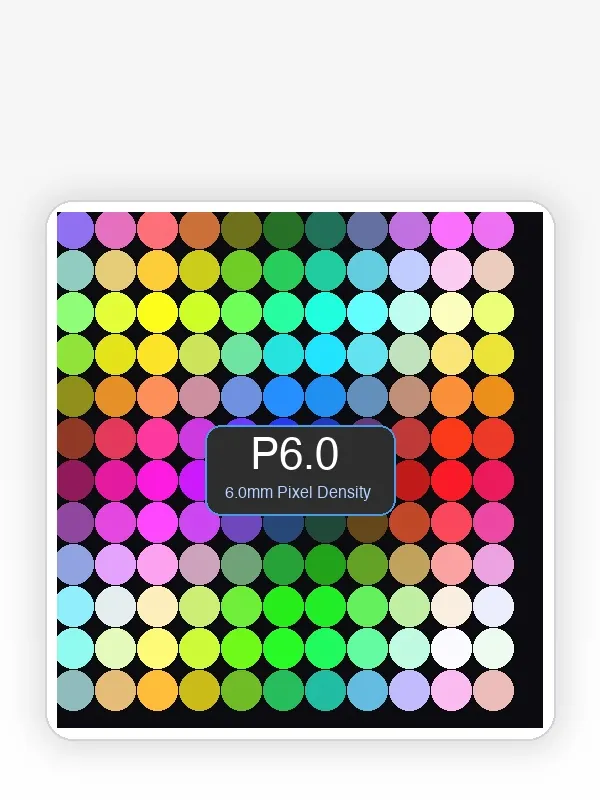
This is the question that sets the pitch. The rule: the closest comfortable distance in metres is roughly the pitch in millimetres, and the picture looks its best from about twice that. If the rule is new to you, read pixel pitch, explained first; it shows why pixels multiply as the pitch shrinks.
Take the tape to where people will actually be, not to the back of the room. Customers across a jewellery counter are about 2 m from the wall behind it. Diners at the nearest restaurant table might be 3 m away. Visitors pass a reception wall at 2.5 to 5 m. A shopfront is read from the pavement and across the road, anywhere from 4 m to 15 m. A hoarding on a main road is read from 20 m and more.
| Pitch | Comfortable from / best around | Right for |
|---|---|---|
| P1.2 indoor, SMD | 1.2 m / 2.5 to 4 m | Control rooms, studios |
| P1.5 indoor, SMD | 1.5 m / 3 to 5 m | Boardrooms, command centres |
| P1.8 indoor | 1.8 m / 3.5 to 6 m | Jewellery counters, conference rooms |
| P2.0 indoor | 2 m / 4 to 7 m | Corporate lobbies |
| P2.5 indoor | 2.5 m / 5 to 8 m | Showrooms, restaurants, temples, halls |
| P2.5 outdoor | 2.5 m / 3 to 5 m | Shopfront menus read up close |
| P3 outdoor | 3 m / 6 to 10 m | Signs read from 3 to 6 m |
| P4 outdoor | 4 m / 8 to 13 m | Storefronts, small billboards |
| P5 outdoor, DIP | 5 m / 10 to 16 m | Building facades |
| P6 outdoor | 6 m / 12 to 20 m | Large facades, highway signs, hoardings |
The finer the pitch, the higher the price per sq ft; the price by pixel pitch page explains why. For your exact price, send us the wall size on WhatsApp and we quote it within minutes. The pixel pitch comparison sets any two pitches side by side.
Question 3: what will the wall show?
Content can push you one step finer, never coarser. Films, product shots, logos and big photographs forgive a coarse grid, because the eye fills the gaps in moving images. Text does not. A menu with small prices, a live dashboard, a spreadsheet in a boardroom or subtitles under a speaker all break up first when the pitch is too coarse for the distance.
So: if the wall will mostly show text read from inside 2 to 3 m, go one step finer than the distance alone suggests. If it shows campaigns and films, stay where the tape measure put you. For scale, an 8 × 4 ft wall at P2.5 is 1,024 × 512 pixels, fine for video and menus but tight for a spreadsheet. The same size in P1.8 is 1,376 × 688 and reads like a large monitor.
Detail on the product matters too. At Amukti's store entrance in a Bengaluru mall, a portrait fine-pitch display replaced a printed lightbox, because shoppers walk right past it and the collection films carry fabric detail.
Question 4: what can you spend?
Price climbs steeply as pitch shrinks, because a finer pitch packs more LEDs into every square foot. Pixels per sq ft scale with one over the pitch squared, so P1.8 carries almost twice the pixels of P2.5 in the same wall. Size, indoor or outdoor, the controller and the structure decide the rest.
When the budget is fixed, the real choice is size against pitch. For a little more than a 10 × 6 ft wall in P1.8, you can have a 12 × 8 ft wall in P2.5, with 60 per cent more screen. If your nearest viewer is 3 m or further away, the bigger P2.5 wall is the better buy, because nobody at that distance can see the extra P1.8 pixels. If people stand at 1.5 m, the smaller P1.8 wall wins.
The rule
Closer seats. Finer pitch.
Everyone else gets a bigger wall for the same money.
Worked examples from Bengaluru rooms
These are typical rooms, not specific customers.
A restaurant feature wall in Koramangala
A 10 × 6 ft wall above the bar, nearest table 3 m away, showing ambience loops, offers and the odd match. Indoor P2.5 fits. A P1.8 wall of the same size would cost noticeably more, and the extra would buy detail nobody at a table can see. More on this on our restaurant LED wall page. For a bar where the match is the product, the sports bar LED wall sizing guide works the same sum from the farthest seat.
A jewellery counter on Commercial Street
An 8 × 6 ft wall behind the counter, with customers seated about 2 m away looking at close-ups of stones and settings. This is where P1.8 earns its higher price over P2.5, which would show its dot structure at that distance. The jewellery showroom page covers counter walls in detail. Colour matters there as much as pitch; the jewellery showroom buying guide covers calibrating the wall against real gold.
A boardroom in Whitefield
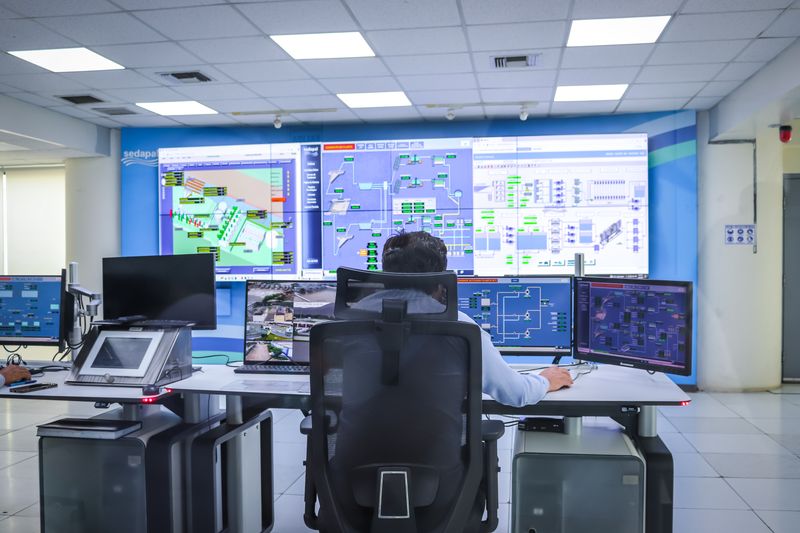
A 10 × 6 ft wall at the end of a table, first chair at 1.5 m, showing spreadsheets and video calls. P1.5 is the honest answer here. If the first chair sits 2 m or more from the wall, P1.8 is enough, and it costs considerably less. Operators reading small text all shift push the pitch finer still; see the control room LED wall guide.
A shopfront in Indiranagar
What the wall does decides the pitch. Açaí Theory chose outdoor P2.5 because its wall is a menu that customers read up close. If your wall is a sign read from across the road instead, outdoor P4 does the job at the same size for a much lower price.
A facade on a main road
A 20 × 10 ft wall on a building face, read from 15 to 30 m by traffic. Outdoor P5 or P6 fits, and P6 costs a little less. On a much larger hoarding P6 is still right, because the size of the screen matters more than a finer pitch. We quote either pitch for your site.
What we talk people out of
- Fine pitch for a far audience. P1.8 in a showroom seen from 5 m costs about half as much again as P2.5 and looks the same.
- “Indoor P4” at a low rate. It is almost always outdoor-grade modules run indoors: too bright even at minimum, and coarse from 3 m. We do not sell indoor P3 or P4; a request for either comes back as a P2.5 quote.
- A normal indoor panel behind street-facing glass. It will look grey by mid-morning.
- Comparing quotes by the P-number alone. Check the module resolution: a 320 × 160 mm P2.5 module carries 128 × 64 pixels.
- A coarse pitch on a small outdoor wall. A 10 × 6 ft P6 wall is only about 530 × 320 pixels, too few for small text or a detailed logo.
Where to go next
If you are still between two pitches, do not decide on paper. Our free site survey measures the real distances, and you see a 3D mockup of the wall in your own space before you pay a rupee. The viewing distance calculator is a good place to start tonight.
Questions? Answers.
Which pixel pitch suits a shop or showroom?
What pixel pitch do I need for an outdoor LED screen?
Should I buy a bigger wall or a finer pitch?
Can an indoor LED wall face the street through a glass front?
Why do two quotes for the same pitch differ so much?
See it running. Then decide.
Send your wall size on WhatsApp for a same-day price, or see indoor and outdoor walls running at our Jalahalli East experience centre in Bengaluru.
Configurator estimates are installed, controller extra, plus 18% GST. What decides the price
PixelSpot builds these walls in Bengaluru and installs them with its own crew across Karnataka. City pages: Bengaluru, Belagavi, Davanagere and every Karnataka district. For your exact price, send the wall size on WhatsApp; we usually quote within minutes.