Business
LED video wall ROI, worked out honestly. With your own numbers.
No promised returns. The cost side from our price sheet, the value side from your own shop, and one formula that shows whether the wall pays for itself.

Anyone who promises you a fixed return on an LED wall is guessing with your money. The honest method is simpler. Add up what the wall costs you each month, list what it can realistically save or earn, and work out how many extra sales it needs to pay for itself. Then decide whether that number is believable for your shop.
The short version
- Cost side: the wall price from our sheet, 18% GST, electricity, content, and upkeep once the 2-year warranty ends.
- Value side: reprints you stop paying for, ad slots you can sell, and extra margin on the items the wall promotes.
- The number that matters is not an ROI percentage. It is the extra sales per month the wall needs to break even.
- In our worked example, a 10 × 6 ft indoor P2.5 wall at ₹3,94,000 + GST needs about 8 extra sales a month to pay back in two years. Your numbers will differ.
- Measure it. Run offers shown only on the screen, so you know what the wall actually sold.
Why most LED wall ROI claims fall apart
Brochures love a big percentage: more footfall, more sales, payback in months. Those numbers come from someone else's shop, street, season and product. They tell you nothing about a saree store in Jayanagar or a mobile shop in Rajajinagar.
What you can know for sure is the cost. What you can estimate honestly is the value, using your own margins and your own printing bills. And what you can measure, after the wall goes live, is whether the screen is selling. Build the case on those three and you are not buying on someone else's numbers.
What does an LED wall really cost you?
The wall itself
Start with a real price, not a range. For a typical in-store wall, a 10 × 6 ft indoor P2.5 is ₹3,94,000 + GST, installed, with the controller. Every size and pitch is on the LED wall price guide, and the configurator prices your exact wall. Structural or civil work, if your site needs it, is quoted separately.
GST
LED walls, controllers and installation carry 18% GST (HSN codes are on our GST and HSN page). If you are GST-registered and use the wall for your business, you can usually claim this back as input tax credit. If you are unregistered or on the composition scheme, you can't, and GST is a real cost. Confirm with your CA.
Electricity
A 10 × 6 ft indoor wall averages about 1.1 kW with normal content. At 10 hours a day that is roughly 335 units a month, or about ₹2,700 at Bengaluru commercial tariffs. Dark backgrounds and a night schedule bring it down. The power consumption guide has figures for other sizes.
Content
Someone has to make and schedule the slides. That is either your own staff's time or a designer's fee. Put a monthly number on it, even if the work is done in-house.
Upkeep
For the first two years, the 2-year pixel-to-pixel onsite warranty covers faults with no charge for parts, labour or call-outs. After that, budget for an AMC or a warranty extension of up to 5 years. Ask for that price in writing before you buy, and add it to year three onward.
What can the wall earn or save?
Reprints you stop paying for
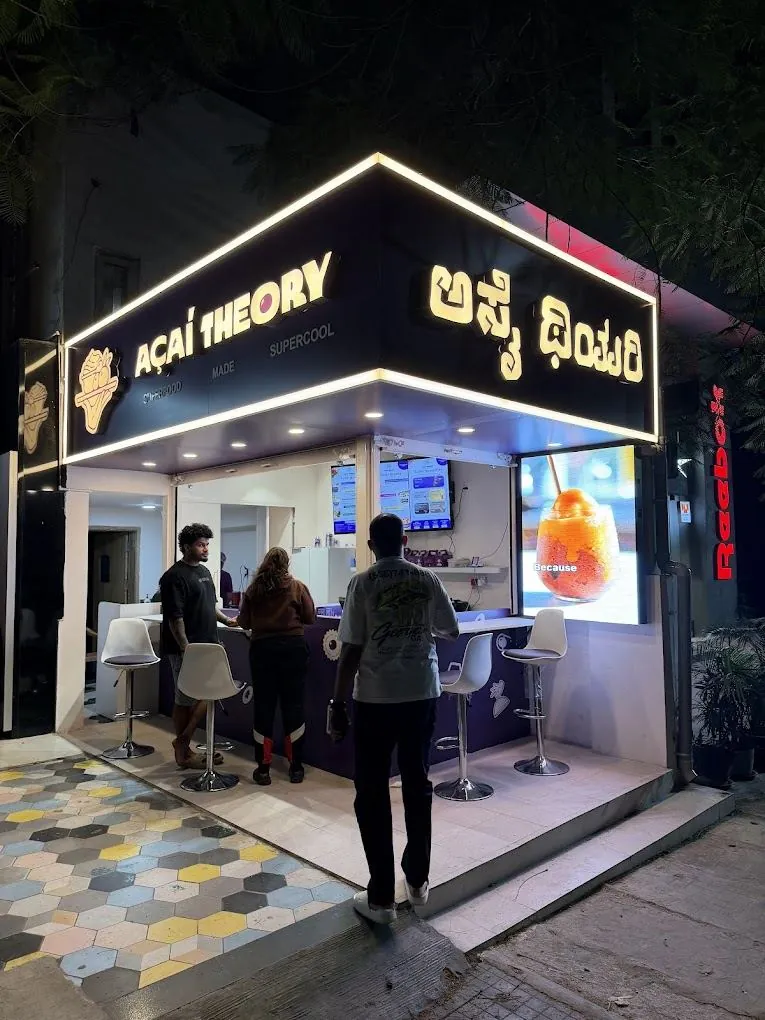
Look at last year's bills. Every flex, vinyl and backlit print, the fixing charges, and the offers that went up late because the printer was busy. That is money a screen replaces with a phone upload. Açaí Theory in Indiranagar runs its café menu that way; five lessons in café LED signage has the story.
Ad slots you can sell
Brands you stock sometimes pay for in-store visibility; ask your distributors whether a spot in your loop qualifies. A street-facing wall can also be listed on the PixelSpot DOOH marketplace, where advertisers book slots and nothing plays without your approval. Be strict here: count zero until a deal is signed. What those advertisers will ask before they book is in the advertiser’s guide to DOOH.
Extra sales from the items the wall promotes
This is the big one, and the one to be most careful with. Only count margin, not revenue, and only on sales you would not have made anyway.
Real, but leave them out of the sums
Faster price changes, a sharper-looking store, staff time saved on printing runs. They matter, but they are hard to price. Treat them as tie-breakers, not as income.
The formula
Instead of guessing a return, ask what the wall needs to sell each month to pay for itself over a period you choose.
Extra sales needed a month: (W ÷ N + E + C − R − A) ÷ G
- W: wall price, plus GST if you cannot claim input credit
- N: months you want it paid back in (24 keeps it inside the warranty)
- E: electricity per month
- C: content per month
- R: printing you stop paying for, per month
- A: ad-slot income per month (zero until signed)
- G: gross margin on one extra sale
Once the wall is live and you are measuring, flip it round: payback, in months: W ÷ (value per month − E − C), where the value per month is the margin you measured plus R and A.
A worked example, with every assumption labelled
Say you run a home-appliance store on a Jayanagar main road and fit a 10 × 6 ft indoor P2.5 wall facing the entrance. You are GST-registered. Every figure marked "assumption" is ours, made up for this example. Replace it with your own.
| Line | Per month | Where it comes from |
|---|---|---|
| Wall, spread over 24 months | ₹16,420 | ₹3,94,000 + GST from our price sheet; GST claimed as input credit |
| Electricity, 10 hours a day | ₹2,700 | Our power guide, Bengaluru commercial tariff |
| Content | ₹6,000 | Assumption: staff time or a freelance designer |
| Printing you stop paying for | −₹4,000 | Assumption: 12 printed changes a year at ₹4,000 each |
| The wall must earn back | ₹21,120 | Before any ad income |
| Margin on one extra sale | ₹3,000 | Assumption: gross margin on a mid-range appliance |
| Extra sales needed | About 8 | ₹21,120 ÷ ₹3,000, rounded up |
Example only, not a forecast. Upkeep is nil here because 24 months sits inside the warranty.
If one brand you stock agreed to pay ₹6,000 a month for a spot in the loop (again, an assumption), the target drops to about 6 extra sales a month. If you are not GST-registered, the wall costs ₹3,94,000 + 18% GST = ₹4,64,920, and the target rises to about 9.
Margin changes everything. Here is the same ₹21,120 a month at different margins per sale:
| Business (hypothetical) | Margin per extra sale | Extra sales needed a month |
|---|---|---|
| Café combo | ₹500 | 43, about one and a half a day |
| Apparel | ₹1,500 | 15 |
| Appliances | ₹3,000 | 8 |
| Jewellery or furniture | ₹10,000 | 3 |
If the wall needs two extra sales a month and your team laughs, buy it. If it needs two hundred, don't.
The honest number
Not a promise. A target.
Extra sales per month is a number your team can check every week, at the billing counter.
How do you measure what the wall actually sold?
- Run a screen-only offer. A combo, a code word or a price shown only on the wall. Count every customer who asks for it.
- Ask at billing. One question, "What brought you in today?", noted for a month.
- Compare like with like. Promote a product on the wall for two weeks, then rest it for two, and compare its sales. Avoid festival weeks, which lift everything.
- Keep the content moving. A wall that never changes stops selling. Our retail content playbook covers what to play and when.
What happens after the payback period?
An LED wall should give 8 to 12 years of daily use before its brightness drops enough to matter, according to our LED wall lifespan guide. Once the wall has paid for itself, your monthly cost falls to electricity, content and upkeep. Every year after that is the real return.
Two things protect it. First, the 2-year pixel-to-pixel onsite warranty, with 5% spare modules from the same batch shipped with the wall. Second, a service plan priced before you buy, not after something fails. If you only need a wall for a few weeks a year, buying may not win at all; our rent-or-buy break-even guide works that out. And if selling screen time is the main plan, read running an LED wall as a revenue line first.
Where to go next
Put your own margin, your own printing bills and a real price into the formula. If the answer is a handful of extra sales a month, you have a business case. Start with W: get it from the LED wall configurator.
Questions? Answers.
What is a realistic ROI for an LED video wall?
Can I claim GST input credit on an LED wall?
How much does it cost to run an LED wall each month?
How do I know if the wall is actually bringing in sales?
See it running. Then decide.
Send your wall size on WhatsApp for a same-day price, or see indoor and outdoor walls running at our Jalahalli East experience centre in Bengaluru.
Prices are estimates: installed, controller extra, plus 18% GST. See every price