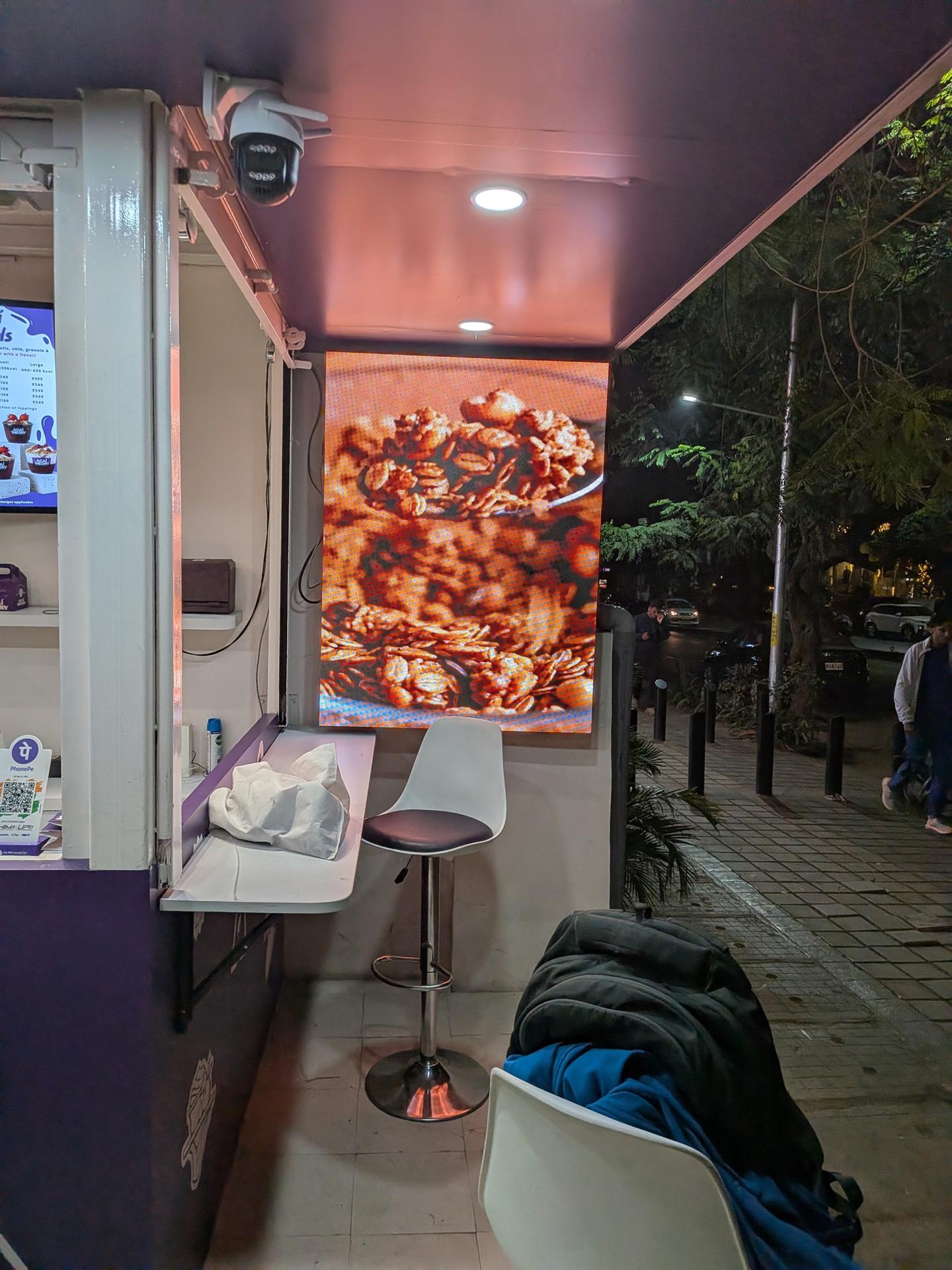
An active LED display is a screen in which every pixel is its own light source: a tiny red, green and blue LED cluster that switches on, off and dims by itself. Nothing sits in front of it and nothing lights it from behind. In the display trade the same product is called a direct-view LED wall, a DVLED, or simply an LED video wall. "Active LED" is the phrase Indian display advertising settled on to separate it from the "LED TV", which is a liquid-crystal panel with an LED backlight. If you learned the term from a brochure and want to know what it means for your budget, this page covers the definition, the specs that decide the price, the 2026 rate per square foot from PixelSpot's Bengaluru factory, and the cases where an LCD wall is still the smarter buy.
What "active" means, and what it does not
You will not find "active LED" in any module maker's datasheet or in an IEC standard. The word contrasts two ways of making a picture. An active (self-emissive) pixel makes its own light: a surface-mount RGB LED soldered to a module PCB and driven by a constant-current driver IC. A passive pixel modulates light it did not make: in an LCD, a white LED backlight shines through a polariser, a liquid-crystal shutter and a colour filter, and the pixel only decides how much of that light escapes. That single difference explains almost everything else on this page: brightness, black level, seams, size limits and where each technology fails.
| What the label says | What the product actually is | How to check |
|---|---|---|
| Active LED display / active LED wall | Direct-view LED: SMD 3-in-1 RGB LEDs on modules, assembled into cabinets, driven by receiving cards | The module resolution is printed on the back: 128 × 64 pixels on a 320 × 160 mm P2.5 module |
| LED TV, LED monitor | An LCD panel with an LED backlight; the liquid crystal is the passive part | Fixed diagonals (55, 65, 75, 86, 98 inch), a bezel, one sheet of glass |
| LCD video wall | A grid of 46 to 55 inch commercial LCDs with thin bezels | Bezel lines of 0.9 to 3.5 mm at every seam |
| Passive LED, backlit LED sign | Not a display at all: a lightbox or channel letters lit from behind by LED strips | The image is a printed film; it cannot change without a new print |
One more source of confusion: the "active matrix" in AMOLED phones refers to a thin-film-transistor addressing scheme, a different meaning entirely. Electrically, an LED wall module is row-scanned (a P2.5 module is typically 1/32 scan), which is why engineers never call the product "active". The word describes the light, not the drive circuit. Treat it as shorthand for direct-view LED and compare quotations on module resolution, nits and pitch, not on the label.
Active LED vs LCD video wall vs LED TV
| Active LED display | LCD video wall | Large LED TV | |
|---|---|---|---|
| How the image is made | Each pixel emits its own light | Backlight through liquid-crystal shutters | Same as an LCD wall, one panel |
| Seams | None at any size | A bezel line at every panel edge | None, but capped at 98 inch |
| Brightness | 800 to 6,500 nits; works in sunlight | 500 to 700 nits, indoor only | Consumer brightness, indoor only |
| Shape and size | Any size, curves, columns, pillars | Multiples of the panel size | Fixed diagonals |
| Close viewing | Needs P1.2 to P1.8 under 2 m | Sharp at arm's length | Sharp at arm's length |
| Lifespan | 8 to 12 years | 5 to 7 years; backlights dim, panels get discontinued | Built for a few hours a day, not 16-hour signage duty |
| What fails and what it costs | One module, ₹1,800 to ₹4,500, swapped in minutes | One whole panel, ₹60,000 to ₹1.2 lakh, hard to batch-match | The whole set |
| 10 × 6 ft indoor, installed | P2.5: ₹3.3 to ₹4.8 lakh | 3 × 3 of 55 inch: ₹4.5 to ₹7 lakh incl. mounts and controller | Not made at this size |
The seven-year running cost, including electricity and the panels that typically fail, is worked through on the LED wall vs LCD video wall page. The short version: for an indoor 10 × 6 ft wall the LCD grid costs more to buy and more to keep, and the seams never go away.
When an active LED display is the right choice
- Viewers stand 2.5 m or further away. Lobbies, showrooms, restaurants, worship halls, stages and auditoriums. At that distance P2.5 looks continuous and costs a fraction of finer pitches.
- Daylight reaches the screen. A glass-fronted showroom, a window facing the street, or a storefront in the afternoon sun. No LCD survives direct sun; a 3,000 to 6,500 nit LED panel is built for it.
- The wall is bigger than a single 98-inch panel, roughly 6 sq m, or needs an odd ratio: 21:9 for a boardroom, portrait for a pillar, a concave curve for a reception.
- The wall will be filmed or photographed. Bezels are ugly on camera; a 3,840 Hz LED wall is invisible to a phone camera at a jewellery counter or a wedding stage.
- It runs 12 to 16 hours a day. Signage duty is what commercial LED modules and power supplies are rated for.
And when it is not: operators reading dense spreadsheets from under 1.5 m are better served by LCD, or by P1.2 LED at ₹18,000 and up per sq ft; a small wall under about 4 sq m on a tight budget is often cheaper as one 86 to 98 inch commercial LCD or an LED standee; and touch interaction still belongs to LCD overlays.
The five spec decisions that set the price
1. Pixel pitch
Pitch is the distance between LED centres in millimetres, and the rule is simple: the minimum comfortable viewing distance in metres is about the pitch number. Note that most "P1.8" modules are 1.86 mm true pitch, "P1.5" is 1.53 and "P1.2" is 1.25; asking for the module resolution on every quote means the pitch cannot be fudged.
| Pitch (true pitch) | Pixels per 320 × 160 mm module | Pixels per sq ft | Nearest viewer | Typical use |
|---|---|---|---|---|
| P1.2 (1.25 mm) | 256 × 128 | 59,458 | 1.2 m | Boardroom, control room |
| P1.5 (1.53 mm) | 208 × 104 | 39,687 | 1.5 m | Conference room, studio |
| P1.8 (1.86 mm) | 172 × 86 | 26,854 | 1.8 m | Reception, office, retail entrance |
| P2.5 (2.5 mm) | 128 × 64 | 14,864 | 2.5 m | Showroom, restaurant, hall, storefront window |
| P4 outdoor (4 mm) | 80 × 40 | 5,806 | 4 m | Shopfront facade, small hoarding |
A 10 × 6 ft P2.5 wall works out to about 1219 × 731 pixels, which plays Full HD content well from 2.5 m. Full details for every pitch are on the price by pixel pitch page.
2. Brightness in nits
Nits are candela per square metre. Too few and the wall is unreadable at 3 pm; too many and it wastes power, hurts eyes at night and shortens the LEDs' life. PixelSpot specifies by location:
- Boardroom or auditorium with controlled light: 500 to 800 nits needed; we fit an 800-nit panel and run it at 30 to 50 per cent, which also gives better blacks.
- Glass-fronted lobby or showroom: 800 to 1,200 nits.
- Behind a window facing the street: 2,500 to 3,500 nits, a semi-outdoor panel that adds roughly 15 to 25 per cent per sq ft at the same pitch.
- Outdoor, shaded or north-facing: 3,500 to 5,000 nits.
- Outdoor in direct or west-facing sun: 5,500 to 6,500 nits, with an ambient light sensor so the wall dims itself after dark. Outdoor walls above 500 nits at night blind drivers and draw complaints, so auto-dimming is standard on every PixelSpot outdoor wall.
Alongside nits, ask for 3,840 Hz refresh (no scan lines on camera), 14 to 16 bit greyscale (smooth gradients in video), a contrast ratio of 4,000:1 or better from black-face LEDs and matte masks, and a 140° to 160° horizontal viewing angle. The brightness guide explains each number.
3. IP rating
Indoor modules are typically IP30 to IP40: safe from dust and fingers, not from water. An outdoor active LED display needs IP65 on the face (dust-tight and proof against water jets) and usually IP54 at the rear inside a sealed cabinet, with rubber gaskets between cabinets. Bengaluru's monsoon runs from June into October, so a single failed gasket is the most common cause of a water-damaged module; we check seals at every annual service. On the Karnataka coast, in Mangaluru, Udupi and Karwar, ask for conformal-coated PCBs, because salt air corrodes solder joints long before the LEDs wear out. A screen behind glass facing the street does not need IP65, but it does need the 3,000-nit panel described above.
4. Cabinet type
Modules are carried in cabinets, and the cabinet decides weight, flatness and how you service the wall. PixelSpot builds indoor walls on die-cast aluminium cabinets, machined flat and weighing about 30 kg per sq m, with front-service modules that lift off the face with a magnet tool. Outdoor walls are built on welded, powder-coated mild-steel (MS) cabinets at about 40 kg per sq m, sealed to IP65 and available with front or rear access. Choose front service whenever the wall sits flush against a building wall, a shopfront opening or a mall pillar, because there will be no room to get behind it. A nominal 10 × 6 ft outdoor wall on MS cabinets weighs roughly 220 kg before the frame, which is why the mounting surface, be it brick, gypsum partition or ACP facade, is checked at the free site survey. The cabinet frames page compares both.
5. Controller, receiving cards and content
A sending card or controller (Huidu A3L to A6L, or NovaStar TB-series) feeds the wall, and each cabinet carries a receiving card, roughly one per 12 modules. NovaStar receiving cards cost more, so ask for the quote to be re-run rather than assuming a Huidu price. Content arrives over HDMI from a room PC, or through PixelOS, PixelSpot's cloud CMS, which lets a cafe owner change the menu from a phone and lets our engineers read the controller remotely before a service visit. Zones, schedules, a night-time dimming curve and a branded idle screen are all set in PixelOS rather than on site.
Active LED screen price per sq ft in Bengaluru, 2026
| Type and pitch | Installed rate per sq ft | 10 × 6 ft wall (60 sq ft) |
|---|---|---|
| Indoor P2.5, most popular | ₹5,500 to ₹8,000 | ₹3.3 to ₹4.8 lakh |
| Indoor P1.8 | ₹7,000 to ₹12,000 | ₹4.2 to ₹7.2 lakh |
| Indoor P1.5 | ₹12,000 to ₹18,000 | ₹7.2 to ₹10.8 lakh |
| Indoor P1.2 | ₹18,000 to ₹25,000 | ₹10.8 to ₹15 lakh |
| Outdoor P4, IP65 | ₹5,000 to ₹8,000 | ₹3 to ₹4.8 lakh |
| Outdoor P3, IP65 | ₹8,000 to ₹12,000 | ₹4.8 to ₹7.2 lakh |
| Outdoor P6 to P10, hoardings | ₹2,500 to ₹6,000 | Priced by facade; see the LED hoarding page |
All rates are before GST. LED walls are invoiced under HSN 8528 at 18 per cent, split as CGST 9 per cent plus SGST 9 per cent when both parties are in Karnataka, and installation goes under SAC 9987; a GST-registered buyer claims the input credit. The rate includes panels, cabinets, controller, power supplies, cabling, installation by PixelSpot's own crew (we never subcontract), commissioning, 5 per cent spare modules from the same batch, PixelOS and the 2-year pixel-to-pixel onsite warranty. What moves a quote within the band: NovaStar control, a 3,000-nit semi-outdoor panel, curved cabinets, structural steel for a facade, scaffolding or a crane above the first floor, and municipal permission for a revenue-earning hoarding. The full list is on the LED wall price guide, and the 60-second configurator gives a GST-inclusive figure for your own size.
Running cost. An indoor 10 × 6 ft wall averages about 1.1 kW on normal video (150 to 250 W per sq m) and peaks at 500 to 700 W per sq m on a full white frame, so the circuit is sized for the peak. At 10 hours a day that is about 335 units a month, or ₹2,680 at ₹8 a unit. Outdoor walls average 250 to 350 W per sq m. The most common failure over the wall's life is a power supply, a 30-minute repair at ₹2,500 to ₹4,000, and an AMC after the warranty starts at about ₹150 per sq ft per year.
Three active LED displays PixelSpot built in Bengaluru
- Acai Theory, Indiranagar: a P2.5 outdoor IP65 wall in a shopfront that faces afternoon sun. A printed menu board disappeared in the glare and a consumer TV could not be read from the pavement, the exact problem an active LED display exists to solve. Front-serviceable modules because there is no rear access, auto-dimming for 10 pm, PixelOS from the owner's phone, fitted during closed hours.
- Amukti store, mall entrance: a portrait display built into the entrance pillar with fine-pitch indoor panels for a 1 to 3 m corridor. It replaced a static lightbox, the "passive" alternative, which needed a new print for every campaign. Cabling runs inside the pillar to a processor in the back office.
- Corporate office cafeteria: a projector washed out under skylights and a row of TVs left bezels across every slide, the two alternatives an active LED wall replaces. A wide-format seamless wall was built to the recess, fed by HDMI from the room PC with a PixelOS idle screen, and installed, calibrated and handed over in one working day. A typical 10 × 6 ft office wall of this kind lands at ₹3.5 to ₹5 lakh including installation.
Installation and service across Bengaluru and Karnataka
PixelSpot has manufactured LED walls at its own Bengaluru factory since 2022, with 500+ installations by its own crew. Every project starts with a free site survey and a 3D mockup of the wall in your actual space, so pitch, brightness and cabinet type are decided on the site, not from a catalogue. The frame is fabricated at the factory, panels are burn-in tested before delivery, and a 10 × 6 ft indoor wall is installed, calibrated and handed over in one working day. Outdoor storefront walls are usually fitted overnight so the shop never shuts. Anywhere in Bengaluru, an engineer reaches the site within 24 hours of a fault call, with power supplies, receiving cards and matched modules from the same batch in stock.
Across Karnataka, from Mysuru, Mangaluru and Hubballi-Dharwad to Belagavi, Kalaburagi, Shivamogga and Tumakuru, the same Bengaluru crew installs and commissions the wall, and service visits are scheduled within the week; remote diagnosis through PixelOS locates most faults before anyone travels. Hosur and Krishnagiri, 40 to 90 km across the Tamil Nadu border, are served from Bengaluru like an outer suburb. We do not install or service elsewhere in India, and we say so rather than promise a crew we cannot send. A screen that will carry third-party advertising is a hoarding under municipal bylaws and needs permission before it goes live; a storefront wall showing your own menu or collections is a different case, and we will tell you which rules apply at the survey. Repair and AMC cover walls of any brand, not only ours, and the vendor comparison shows what to check before you sign with anyone.
Get an exact quote: WhatsApp the wall size and location to +91 72048 08334 or use the 60-second configurator. Site survey and 3D mockup are free across Bengaluru and Karnataka.
Need Help Choosing the Right LED Display?
Get a free consultation and instant quote from PixelSpot experts.
Get Free Quote →