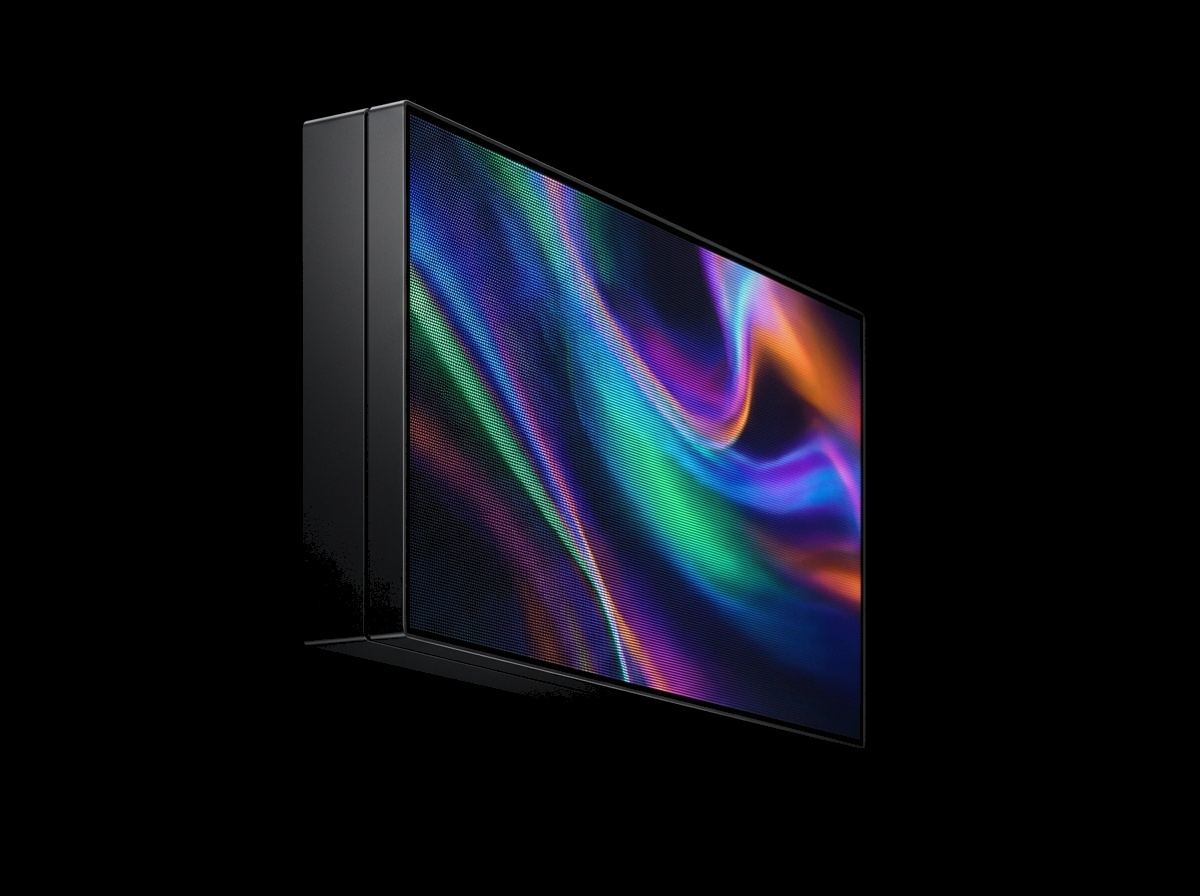
A P2.5 LED wall costs ₹5,500 to ₹8,000 per sq ft installed, before GST, from PixelSpot's factory in Bengaluru. That makes a 10x6 ft wall ₹3.3 to ₹4.8 lakh. Every other pitch on this page, from P1.2 fine pitch to P10 hoarding modules, is priced the same way: the installed rate per square foot, then the total for an 8x4, a 10x6 and a 12x8 ft wall, with the resolution each size gives you. The rate includes LED modules, receiving cards, the controller, power supplies, the steel frame, cabling, installation by our own crew, PixelOS cloud CMS, 5 per cent spare modules and the 2-year pixel-to-pixel onsite warranty. GST at 18 per cent is extra; the HSN and GST page explains the input credit.
What pixel pitch is, and why the number drives the price
Pixel pitch is the distance between the centres of two neighbouring LEDs, in millimetres. P2.5 means 2.5 mm. Halve the pitch and you do not double the LED count, you quadruple it: pixel density is (1,000 ÷ pitch) squared per square metre, so P2.5 carries 160,000 pixels per square metre (14,864 per sq ft) while P1.2 carries 640,000 (59,458 per sq ft). Four times the LEDs, four times the driver ICs, and a scan rate that lights each LED for a shorter slice of time, which needs better drivers to hold brightness. That is the whole reason a P1.2 wall costs three to four times a P2.5 wall of the same size.
Two naming details matter when you compare quotes. First, the round names hide the real pitch: in the standard 320 x 160 mm module family, "P1.2" is 1.25 mm, "P1.5" is 1.53 mm and "P1.8" is 1.86 mm, so two vendors quoting "P1.8" may be quoting slightly different pixel counts. Second, the module resolution tells you the truth: a 320 x 160 mm module carries 128 x 64 pixels at P2.5, 160 x 80 at P2.0, 172 x 86 at P1.86, 208 x 104 at P1.53 and 256 x 128 at P1.25. Ask for the module resolution on every quote and the pitch cannot be fudged.
The viewing-distance rule that picks your pitch
The minimum comfortable viewing distance in metres is roughly the pitch number, and the picture looks best from about twice that. P2.5 is comfortable from 2.5 m and ideal from 5 m; P1.8 from 1.8 m and ideal from 3.5 m; outdoor P4 from 4 m and ideal from 8 m. Closer than the minimum and you can see individual LED dots; much further and you paid for pixels nobody can resolve. Measure where the nearest regular viewer stands, not the room size. A jewellery counter with customers leaning in wants P1.8; a showroom wall seen from the floor wants P2.5; a shopfront read from the pavement wants outdoor P4 or, where people read a menu from 3 to 5 m as at Acai Theory in Indiranagar, outdoor P2.5. The viewing distance calculator has the full table.
Indoor LED wall price by pixel pitch
These are the indoor pitches PixelSpot builds and stocks spares for in Bengaluru. Prices are installed, per sq ft, before GST. The lower figure is a plain wall-mounted install with a Huidu controller; the upper figure covers front-service die-cast cabinets, a NovaStar-based system, curved or ceiling-hung frames and semi-outdoor brightness.
| Pitch (true pitch) | Per sq ft | 8x4 ft (32 sq ft) | 10x6 ft (60 sq ft) | 12x8 ft (96 sq ft) |
|---|---|---|---|---|
| P1.2 (1.25 mm) | ₹18,000 to ₹25,000 | ₹5.76 to ₹8 lakh | ₹10.8 to ₹15 lakh | ₹17.28 to ₹24 lakh |
| P1.5 (1.53 mm) | ₹12,000 to ₹18,000 | ₹3.84 to ₹5.76 lakh | ₹7.2 to ₹10.8 lakh | ₹11.52 to ₹17.28 lakh |
| P1.8 (1.86 mm) | ₹7,000 to ₹12,000 | ₹2.24 to ₹3.84 lakh | ₹4.2 to ₹7.2 lakh | ₹6.72 to ₹11.52 lakh |
| P2.0 (2.0 mm) | ₹8,000 to ₹12,000 | ₹2.56 to ₹3.84 lakh | ₹4.8 to ₹7.2 lakh | ₹7.68 to ₹11.52 lakh |
| P2.5 (2.5 mm), most popular | ₹5,500 to ₹8,000 | ₹1.76 to ₹2.56 lakh | ₹3.3 to ₹4.8 lakh | ₹5.28 to ₹7.68 lakh |
P1.8 and P2.0 overlap almost completely in price, and on some batches the finer 1.86 mm module is the cheaper one because it is made in larger volumes. If a quote for "P2" lands above or below a quote for P1.8, check the module resolution before assuming anything: 160 x 80 pixels is P2.0, 172 x 86 is P1.86.
Indoor specification by pitch
| Pitch | Module (320 x 160 mm) | Scan | Pixels per sq ft | Brightness | Minimum distance |
|---|---|---|---|---|---|
| P1.2 | 256 x 128 px | 1/64 | 59,458 | 800 to 1,000 nits | 1.2 m |
| P1.5 | 208 x 104 px | 1/52 | 39,687 | 800 to 1,000 nits | 1.5 m |
| P1.8 | 172 x 86 px | 1/43 | 26,854 | 800 to 1,000 nits | 1.8 m |
| P2.0 | 160 x 80 px | 1/40 | 23,226 | 800 to 1,000 nits | 2 m |
| P2.5 | 128 x 64 px | 1/32 | 14,864 | 800 to 1,200 nits | 2.5 m |
Refresh rate is 3,840 Hz on current-generation modules at every one of these pitches; 1,920 Hz panels are cheaper and flicker on phone cameras, which matters for any wall that will be filmed. Grey scale of 14-bit or better and a factory colour temperature of 6,500 K are the other two lines to look for on the spec sheet.
Where are indoor P3 and P4?
PixelSpot does not sell them, and it is worth knowing why. Once the cabinet, frame, controller, power supplies, cabling and two days of crew are the same, the module saving between indoor P3 and P2.5 is small, so an indoor P3 request from us comes back as a P2.5 quote at ₹5,500 per sq ft with 44 per cent more pixels. Indoor P4 quotes you may see elsewhere at ₹3,000 per sq ft are almost always outdoor-grade P4 modules run indoors: too bright even at minimum, coarse from 3 m, and with only 80 x 40 pixels per module a 10x6 ft wall comes to 762 x 457 pixels, below the resolution of a 2005 desktop monitor.
Resolution you get at each size (indoor)
Wall width in millimetres divided by the pitch gives pixels across. Real walls round to whole modules and cabinets, so the built figure is within one module of these. Full HD content is 1,920 x 1,080; anything above roughly 1,200 pixels wide shows a Full HD video without visible softening from 2.5 m.
| Pitch | 8x4 ft (2,438 x 1,219 mm) | 10x6 ft (3,048 x 1,829 mm) | 12x8 ft (3,658 x 2,438 mm) |
|---|---|---|---|
| P1.2 | 1,950 x 975 (1.9 MP) | 2,438 x 1,463 (3.6 MP) | 2,926 x 1,950 (5.7 MP) |
| P1.5 | 1,593 x 796 (1.3 MP) | 1,992 x 1,195 (2.4 MP) | 2,390 x 1,593 (3.8 MP) |
| P1.8 | 1,310 x 655 (0.9 MP) | 1,638 x 983 (1.6 MP) | 1,966 x 1,310 (2.6 MP) |
| P2.0 | 1,219 x 609 (0.7 MP) | 1,524 x 914 (1.4 MP) | 1,829 x 1,219 (2.2 MP) |
| P2.5 | 975 x 487 (0.5 MP) | 1,219 x 731 (0.9 MP) | 1,463 x 975 (1.4 MP) |
The practical reading: an 8x4 ft P2.5 wall at 975 pixels wide is fine for video, logos and menus but tight for a spreadsheet; the same 8x4 in P1.8 gives 1,310 pixels and reads like a large monitor. At 12x8 ft, P2.5 already passes 1,400 pixels wide and finer pitch buys nothing unless the front row is inside 2.5 m. That is the logic behind the corporate cafeteria wall we built in Bengaluru: the pitch was chosen from the nearest seat, not from a resolution target.
Outdoor LED wall price by pixel pitch
Outdoor modules are IP65-sealed on the front, IP54 at the rear, run 5,000 to 6,500 nits for direct Bengaluru sun and dim automatically at night. Cabinets are 960 x 960 mm or 1,280 x 960 mm rather than the indoor 640 x 480 mm die-cast, which is why outdoor walls are quoted in slightly coarser size steps. Prices are installed, per sq ft, before GST, for a wall-mounted or fascia install; a freestanding pole or gantry structure and any municipal permission drawings are separate lines.
| Pitch | Per sq ft | 8x4 ft (32 sq ft) | 10x6 ft (60 sq ft) | 12x8 ft (96 sq ft) |
|---|---|---|---|---|
| P3 outdoor | ₹8,000 to ₹12,000 | ₹2.56 to ₹3.84 lakh | ₹4.8 to ₹7.2 lakh | ₹7.68 to ₹11.52 lakh |
| P4 outdoor, storefront standard | ₹5,000 to ₹8,000 | ₹1.6 to ₹2.56 lakh | ₹3 to ₹4.8 lakh | ₹4.8 to ₹7.68 lakh |
| P5 outdoor | ₹4,000 to ₹6,500 | ₹1.28 to ₹2.08 lakh | ₹2.4 to ₹3.9 lakh | ₹3.84 to ₹6.24 lakh |
| P6 outdoor | ₹3,500 to ₹6,000 | ₹1.12 to ₹1.92 lakh | ₹2.1 to ₹3.6 lakh | ₹3.36 to ₹5.76 lakh |
| P8 / P10 outdoor | ₹2,500 to ₹4,500 | ₹0.8 to ₹1.44 lakh | ₹1.5 to ₹2.7 lakh | ₹2.4 to ₹4.32 lakh |
The P6, P8 and P10 columns for 8x4 and 10x6 ft are arithmetic, not advice: a 10x6 ft P10 wall is only 304 x 182 pixels, which cannot draw a logo cleanly. Those pitches are for LED hoardings of about 200 sq ft and more, read from 12 to 30 m. Below 100 sq ft outdoors we quote P4, or P3 where people read from 3 to 6 m. Outdoor P2.5, as used on the Acai Theory shopfront, is quoted on request above the P3 band.
Outdoor specification by pitch
| Pitch | Module | Scan | Brightness | Minimum distance | 12x8 ft resolution |
|---|---|---|---|---|---|
| P3 | 192 x 192 mm, 64 x 64 px | 1/16 | 5,000 nits | 3 m | 1,219 x 812 |
| P4 | 320 x 160 mm, 80 x 40 px | 1/10 | 5,000 to 6,500 nits | 4 m | 914 x 609 |
| P5 | 320 x 160 mm, 64 x 32 px | 1/8 | 5,500 to 6,500 nits | 5 m | 731 x 487 |
| P6 | 192 x 192 mm, 32 x 32 px | 1/8 | 5,500 to 6,500 nits | 6 m | 609 x 406 |
| P8 | 320 x 160 mm, 40 x 20 px | 1/5 | 6,000 nits and up | 8 m | 457 x 304 |
| P10 | 320 x 160 mm, 32 x 16 px | 1/4 | 6,000 nits and up | 10 m | 365 x 243 |
Outdoor refresh is 1,920 to 3,840 Hz depending on the driver IC; specify 3,840 Hz for any facade that will appear in reels or on television. A west-facing wall in Bengaluru needs the top of the nits range; a north-facing or shaded one is fine at 5,000 nits. The brightness guide covers the semi-outdoor case of a screen behind glass, which needs 2,500 to 3,500 nits and adds roughly 15 to 25 per cent to the indoor rate at the same pitch.
P1.8 vs P2.5: the upgrade question we get most
Nearly every indoor buyer in Bengaluru ends up choosing between these two, so here they are side by side on a 10x6 ft wall.
| Spec | P1.8 (1.86 mm) | P2.5 (2.5 mm) |
|---|---|---|
| Module resolution, 320 x 160 mm | 172 x 86 px | 128 x 64 px |
| Pixel density | 289,051 per m², 26,854 per sq ft | 160,000 per m², 14,864 per sq ft |
| 10x6 ft resolution | 1,638 x 983 (1.6 MP) | 1,219 x 731 (0.9 MP) |
| Scan rate | 1/43 | 1/32 |
| Refresh rate | 3,840 Hz | 3,840 Hz |
| Brightness | 800 to 1,000 nits | 800 to 1,200 nits |
| Minimum viewing distance | 1.8 m | 2.5 m |
| Per sq ft installed | ₹7,000 to ₹12,000 | ₹5,500 to ₹8,000 |
| 10x6 ft wall, before GST | ₹4.2 to ₹7.2 lakh | ₹3.3 to ₹4.8 lakh |
| Right for | Boardrooms, jewellery counters, mall entrances, dashboards and spreadsheets | Showrooms, restaurants, temples and churches, wedding halls, lobbies, events |
The difference on a 10x6 ft wall is about ₹90,000 at the entry price. From 3.5 m the two are indistinguishable; from 1.5 m the P2.5 shows its dot structure and small fonts break up. So the decision is a tape-measure job: if anyone regularly stands or sits inside 2 m of the wall, or the content is text-dense, pay for P1.8. The Amukti store entrance in a Bengaluru mall is the P1.8 case, with shoppers passing at 1 to 3 m and fabric detail to show; a showroom feature wall seen from the floor is the P2.5 case. Below P1.8, P1.5 and P1.2 are for people sitting at a table in front of the screen, which is a control room or boardroom, not a retail space.
Specs that move the price besides pitch
- Brightness in nits. Standard indoor is 800 to 1,000 nits run at 30 to 50 per cent. A glass-fronted lobby wants 1,200. Semi-outdoor at 2,500 to 3,500 nits adds 15 to 25 per cent per sq ft; full outdoor IP65 at 5,000 nits and up is a different module and cabinet and is priced from the outdoor table.
- Cabinet and service access. Indoor 640 x 480 mm die-cast aluminium cabinets with front-service magnetic modules cost a little more per sq ft than rear-service steel, and save a lot when the wall sits flush against a building wall with no rear access, which is most Bengaluru offices and shopfronts.
- Controller. A Huidu system is the entry price; a NovaStar sending card and receiving cards cost more per cabinet. Both are on our list, and the controller model is named on every PixelSpot quote so it can be compared like for like.
- Refresh and grey scale. 3,840 Hz and 14-bit or better is the current standard; a 1,920 Hz, 12-bit panel is cheaper and looks the same to the eye until a camera or a dark scene is involved.
- Power. Finer pitch draws more per sq ft at peak, so P1.5 and P1.2 walls need a larger dedicated circuit and a stabiliser is strongly advised. The power consumption guide has the figures by pitch.
- Frame and mounting. Wall-mounted on a flat surface is the base price. Curved, ceiling-hung, portrait pillars and freestanding structures add fabrication time, quoted after the free site survey.
Installed price in Bengaluru and across Karnataka
PixelSpot has built LED walls at its own Bengaluru factory since 2022, with more than 500 installs to date, and the crew that assembles and burn-in tests your wall is the crew that installs it; nothing is subcontracted. Within Bengaluru the site survey and 3D mockup are free, delivery and installation are included in the per sq ft rate, and service response is within 24 hours. Across the rest of Karnataka, from Mysuru and Mangaluru to Hubballi, Belagavi and Kalaburagi, the pitch rates on this page are unchanged; the quote adds freight and crew travel as separate lines so you can see them. Hosur and Krishnagiri, 40 to 90 km from the factory, are served as Bengaluru neighbours. See the Bengaluru page and the Karnataka districts page for how a project runs in each.
How to get an exact price for your pitch and size
- Measure the wall opening and the distance to the nearest regular viewer. That fixes the pitch.
- Use the 60-second LED wall configurator for an instant estimate with GST, spec sheet and BOM, or WhatsApp the size, indoor or outdoor, and a photo of the wall to +91 72048 08334.
- Book the free survey. We confirm the pitch on site, check power and access, and send a 3D mockup of the wall in your actual space with a fixed quotation.
The LED wall price guide covers what is included in more depth, and the size pages give worked totals for 8x4 ft, 10x6 ft and 12x8 ft walls.
Need Help Choosing the Right LED Display?
Get a free consultation and instant quote from PixelSpot experts.
Get Free Quote →