Every kind of LED screen. Built in Bengaluru. Installed across India.
PixelSpot builds full-colour LED screens at its own factory in Jalahalli, Bengaluru: display boards, shop screens, outdoor screens and hoardings, indoor walls, LED TVs and standees. Our own crew installs them across Karnataka, and we deliver and install walls across India.
An outdoor P2.5 LED screen we built for Açaí Theory, Indiranagar. It reads in afternoon sun and dims itself after dark.
2 yrpixel-to-pixel onsite warranty
Own factoryJalahalli, Bengaluru
Own crewinstallation, no subcontractors
65+walls installed
5.0on Google (15 reviews)
What an LED screen is.
An LED screen is a display in which every pixel is its own light: a tiny cluster of red, green and blue LEDs. Modules of pixels sit in cabinets, the cabinets join edge to edge with no bezel, and a controller turns your video into the picture. Because the pixel makes its own light, an LED screen can be any size and bright enough for direct sun. The trade calls it direct-view LED, an active LED display or an LED video wall. Most "LED TVs" in electronics shops are something else: LCD panels lit from behind, with a fixed size and a bezel.
Modules
The pixels. Pitch is the gap between them in millimetres: P2.5 means 2.5 mm. Ask for the module resolution on every quote, so the pitch cannot be fudged.
Cabinets
Indoor cabinets are IP43. Outdoor cabinets are IP65 at the front and IP54 at the rear. Front-service cabinets let a screen sit flush against a wall.
Controller and software
A Huidu or Novastar controller drives the screen. PxlOS, our own software, changes what it shows from your phone.
Which LED screen fits.
Start with where the screen goes and how close the nearest viewer stands. The pitch and the brightness follow.
A flat, full-colour LED panel cut to board sizes: 6 × 4 ft on a shop wall, 8 × 4 ft over a fascia, a portrait panel beside a door. The message changes from a phone. Inside, the standard board is P2.5; choose P2.0 for counters and rate boards with small text. Outside, P4 is the usual fascia board and P6 suits boards read from further away. We do not build single-colour scrolling boards.
Three things are sold as an "LED sign board": lit letters, a backlit glow sign, and a full-colour LED display. Sign fabricators make the first two; we make the third, a screen that carries the menu and the offers without a reprint. If your sign only ever says your name, lit letters cost far less. Signs facing the street use outdoor panels: P4 to P6 on a fascia, P2.5 or P3 in a window.
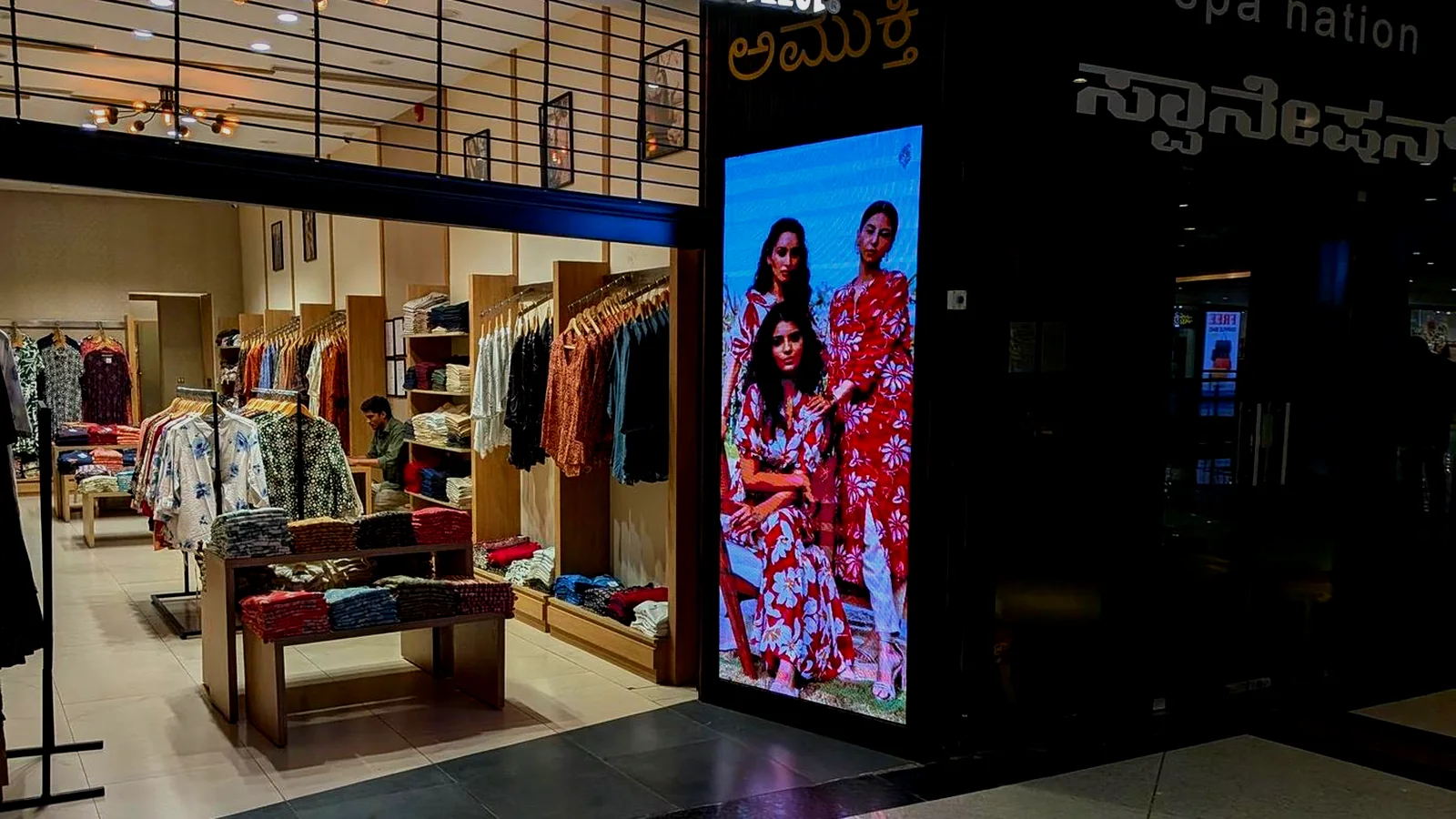
A portrait fine-pitch screen in the entrance pillar at Amukti, in a Bengaluru mall.
Most shops start with a 6 × 4 ft indoor P2.5 screen on the back wall or above the counter. A jeweller, whose customers stand a metre away, steps to P2.0 or P1.8. A showroom usually runs P2.5 on the main wall, P1.8 where customers stand within 2 m, and outdoor P4 on the facade. One rule saves regret: a screen in a window or behind street-facing glass gets an outdoor-grade panel, or it disappears by noon.
Outdoor screens run at up to 4,500 nits, which reads in Indian daylight, and dim after dark, because above about 500 nits at night a screen is glare. Cabinets are IP65 at the front and IP54 at the rear; outdoor P3, P4 and P6 use 320 × 160 mm modules. Narrow-pavement shopfronts suit P2.5 or P3, most shopfronts P4, set-back facades P5 (DIP), rooftops and highway faces P6, and very distant faces P8 or P10.
A hoarding is a structure first, so the survey checks the frame, wind load, power and service access. Local rules decide what an advertising screen may show: in Bengaluru, road-facing ad screens show still images that change after at least ten seconds. For a one-off sale or a message that never changes, a flex banner is still the right answer.
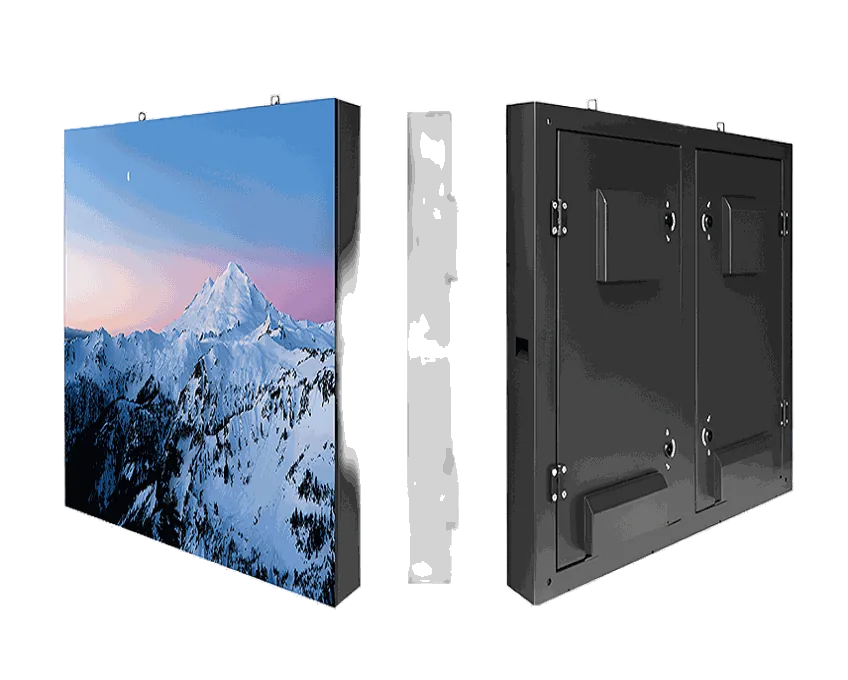
An indoor LED cabinet, front and back. Cabinets join edge to edge into one screen.
For lobbies, boardrooms, restaurants, temples, halls and auditoriums, in P1.2, P1.5, P1.8, P2.0 and P2.5, at up to 600 nits. Most indoor screens run at 30 to 50 percent, easier on the eye and on the screen's life. Cabinets are IP43 and front-serviceable. P2.5 is the most-bought indoor pitch and the coarsest we sell; for a big hall it is still the answer, as we do not sell indoor P3. Large walls are covered on our LED video wall page.
A PixelSpot LED TV is not an LCD. It is direct-view LED at P1.5, with no bezel, in a TV-like frame for boardrooms, cabins, studios and home theatres: the X-650 Air (65-inch class), X-750 Pro (75-inch class) and X-900 Max (90-inch class), each up to 600 nits. Custom sizes are built to order. Choose one when you want a picture larger than a TV or a ratio a TV does not come in.
Projectors wash out with the lights on and TV banks put bezels through the score bar; an indoor P2.5 LED wall does neither. The nearest seat decides the pitch; the farthest decides the size. A 10 × 6 ft wall reads to about 10 to 12 m, 12 × 8 ft to 15 m, 16 × 9 ft to 18 to 20 m. After 10 pm most bars run at 20 to 30 percent brightness, scheduled in PxlOS.
"Active LED" is the phrase Indian display advertising uses for direct-view LED, to set it apart from an LED-backlit LCD. It is the same product as an LED video wall, so compare quotes on module resolution, nits and pitch, not on the label.
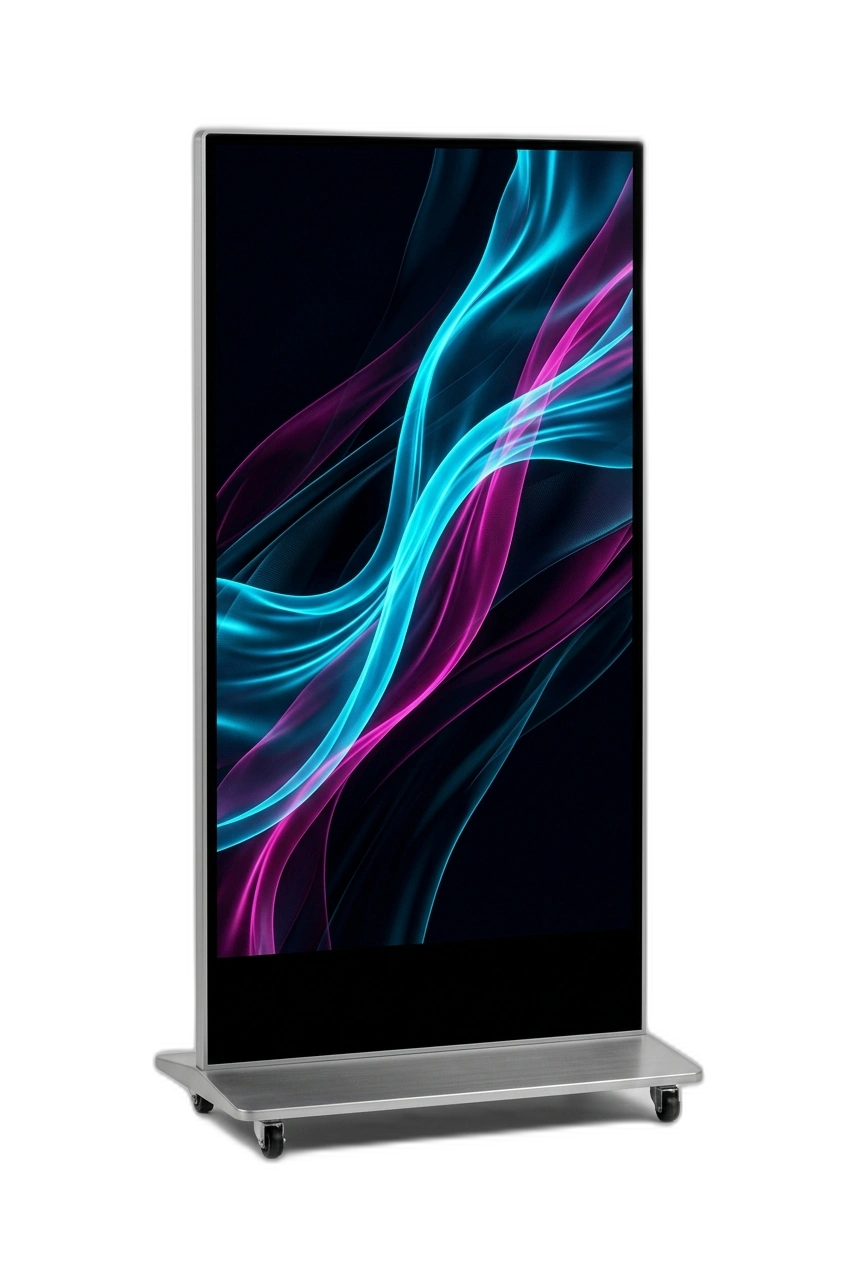
A slim LED screen on its own stand: plug it in and wheel it to wherever the crowd is. Our LED standees come in 2 × 4, 2 × 5 and 3 × 5 ft, indoor and outdoor, from P1.5 to P4, for mall floors, entrances, lobbies and events. For a screen that never moves, a wall or board is the better buy.
Flex wins for a one-off sale, a temporary site or a message that never changes. An LCD wins for dense text read from under 1.5 m, for touch, and often for one small screen on a tight budget.
Daylight reaches it, it must be bigger than one TV, it must be seamless, it runs 12 to 16 hours a day, or it will be filmed: a 3,840 Hz screen does not flicker on camera.
The minimum comfortable viewing distance in metres is roughly the pitch number. The nearest regular viewer decides the pitch; the farthest viewer and the content decide the size.
A screen grows in cabinet steps, so the survey fits it to your wall. Small text needs more pixels than a logo, so tell us what the content carries. Run your numbers on the viewing distance calculator and the size calculator, or compare pitches in the pixel pitch guide.
Brightness, weather and what goes inside.
Brightness that fits
Indoor up to 600 nits, outdoor up to 4,500 nits, auto-dimming at night. A screen behind street-facing glass gets the outdoor panel.
Sealed for the site
Indoor cabinets IP43. Outdoor cabinets IP65 at the front and IP54 at the rear, for monsoon, dust and heat.
Camera-safe
3,840 Hz refresh or above, so the screen does not roll on a phone camera.
Power done properly
Polycab branded wiring and 60 A power supplies with cooling fans. Power supplies fail most often, so we do not save money there.
Serviceable
Front-service cabinets where needed, and 5% spare modules from the same batch, free.
Tested first
Huidu or Novastar controllers. Every screen is burn-in tested at our Jalahalli factory before it ships.
Content with PxlOS.
Every PixelSpot screen runs on PxlOS, our own content software. Upload a video or picture from your phone, build a playlist and schedule it by the hour or the day. The screen updates in seconds, dims itself on a schedule, and lets our team diagnose faults remotely. Running screens across branches is covered on digital signage.
Power and lifespan.
Power
Normal video averages 25 to 35 percent of peak. Indoor P1.5 to P2.5 averages 14 to 23 W per sq ft; outdoor P3 to P6, 23 to 33 W. A 10 × 6 ft indoor screen averages about 1.1 kW, roughly 335 units a month at 10 hours a day, and peaks near 3.9 kW, so its line is sized for the peak.
LED modules last 8 to 12 years of daily use before brightness halves. Power supplies last 3 to 6 years and are the most common failure; cabinets last 15 years and more. Moderate brightness, clean power and a yearly service keep a screen going past ten years.
Pixel pitchScreen sizeIndoor or outdoorControllerStructureSite access
Six things move the figure, so we quote each screen for its site. Finer pitches cost more, which is why the nearest viewer should decide the pitch. The controller is chosen by pixel count. A quote covers the screen, the structure and installation by our crew; GST at 18% is added, and freight is a line on the quote outside Karnataka. The configurator gives an estimate in a minute, and our team then calls with the best price. Every screen is bought outright.
Our own crew installs LED screens in Bengaluru and across Karnataka, and we deliver and install walls across India: built and tested in Bengaluru, sent by road, mounted and calibrated by the same crew. After handover the warranty applies wherever the screen is, and a single dead pixel is covered.
What is the difference between an LED screen and an LED TV?
An LED screen is direct-view LED: every pixel makes its own light, so it can be any size, seamless and bright enough for sunlight. Most LED TVs are LCD panels with an LED backlight, in fixed sizes with a bezel. PixelSpot's own LED TVs are direct-view LED at P1.5.
Which LED screen is right for a shop?
Inside, most shops start with a 6 x 4 ft indoor P2.5 screen; a jeweller steps to P2.0 or P1.8. A screen in a window or on the fascia needs an outdoor-grade panel, usually P4, because daylight washes out an indoor panel.
What pixel pitch do I need?
Go by the nearest regular viewer: the comfortable distance in metres is about the pitch in millimetres. P1.2 to P1.5 under 1.5 m, P1.8 or P2.0 up to 2.5 m, indoor P2.5 beyond that, outdoor P4 to P5 for 4 to 6 m, and P6 to P10 for hoardings.
Can an LED screen be read in direct sunlight?
An outdoor PixelSpot screen can. It runs at up to 4,500 nits and dims automatically after dark. Outdoor cabinets are IP65 at the front and IP54 at the rear. Indoor panels, at up to 600 nits, are for interiors.
How much does an LED screen cost in India?
It depends on the pixel pitch, the size, indoor or outdoor, the controller, the structure and site access. Use the configurator to get your estimate, or send your size on WhatsApp to +91 72048 08334, and our team will call with the best price.
Do you install LED screens outside Bengaluru?
Yes. Our own crew installs across Karnataka, and we deliver and install walls across India. Every screen is built and tested in Bengaluru, sent by road, and installed by the same crew.
How long does an LED screen last, and what is the warranty?
LED modules last 8 to 12 years of daily use before brightness halves. Every PixelSpot screen carries a 2-year pixel-to-pixel onsite warranty and ships with 5% spare modules, free.
Can I rent an LED screen from PixelSpot?
No. We do not rent LED screens. For a one-off event, an event company that rents screens is the right call. If you will use a screen several days a month, owning one costs less over time, and that is what we build.
Tell us where the screen goes.
Size, site and viewing distance are enough to start. Get your estimate in a minute; our team calls with the best price.
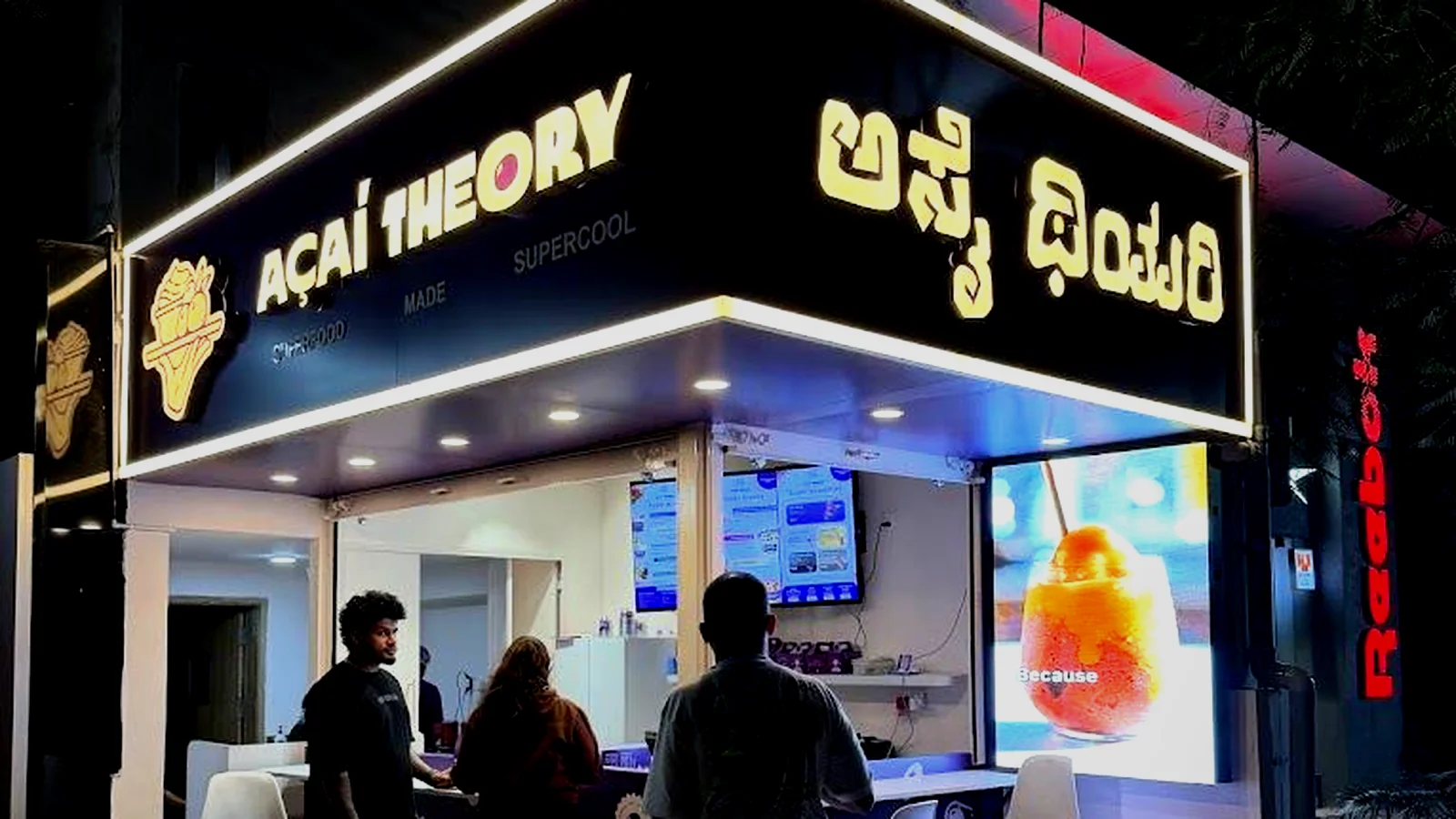
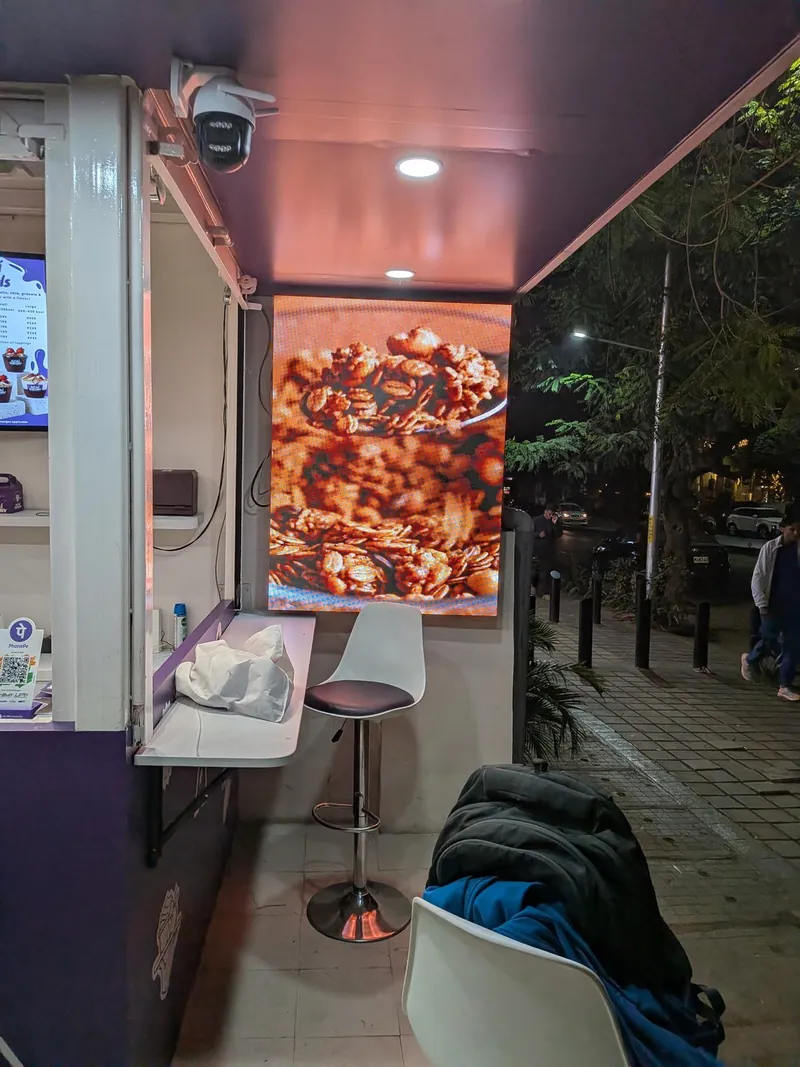 Açaí Theory, Indiranagar
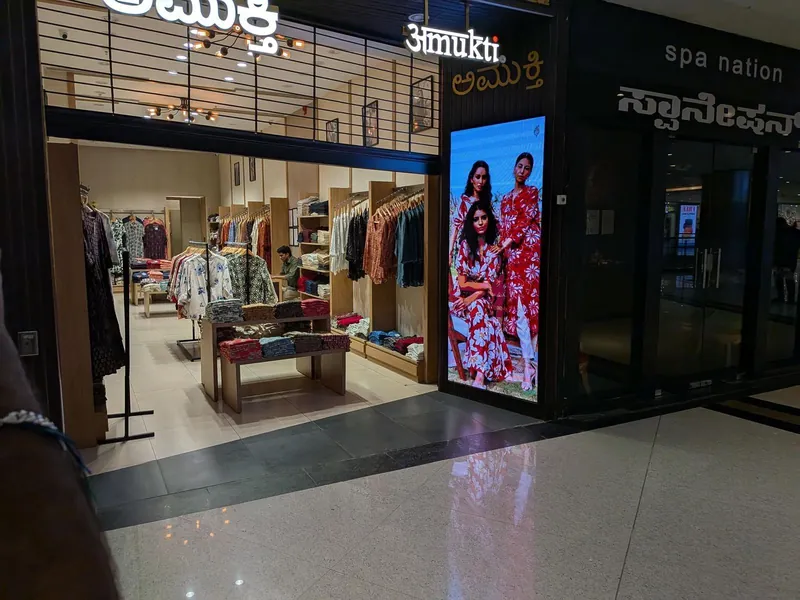 Amukti, Bengaluru mall
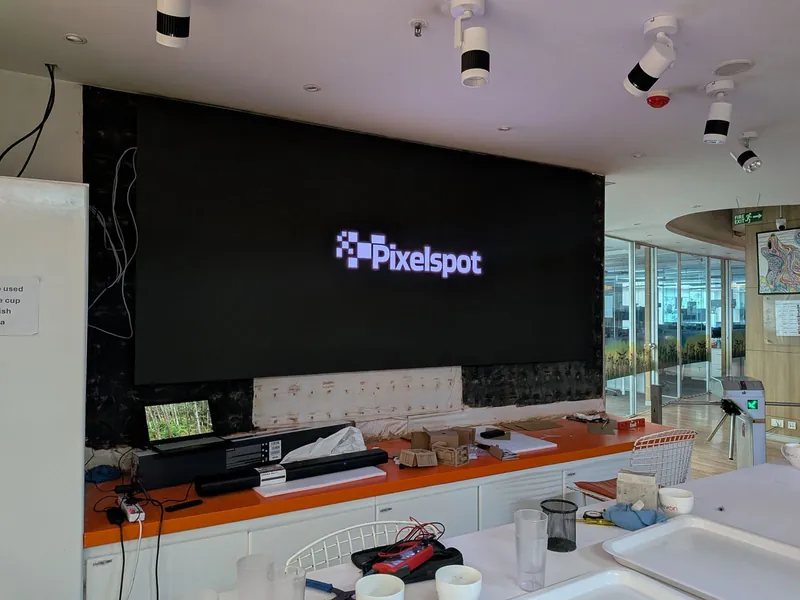 Corporate office, Bengaluru