LED video walls, made in India.
Seamless. Bright. Built in our own factory.
PixelSpot designs and builds indoor and outdoor LED video walls at its own factory in Jalahalli, Bengaluru, from fine-pitch P1.2 boardroom walls to P10 hoardings read from the road. Our own crew installs every wall in Bengaluru, across Karnataka and in cities across India, and every wall carries a 2-year pixel-to-pixel onsite warranty.

What an LED video wall is.
An LED video wall is one large screen built from small LED modules. Each module is a circuit board carrying a grid of red, green and blue LEDs; on the walls we build it is usually 320 × 160 mm. Modules fix onto cabinets, cabinets lock together into a wall of almost any size, and a controller takes your video, slices it and sends each piece to the right module. Because the modules butt edge to edge, there are no bezels.
The number that matters most is the pixel pitch: the distance in millimetres between the centres of two neighbouring pixels. P2.5 means 2.5 mm. A smaller pitch packs more pixels into the same area, so people can stand closer before they see dots, and it costs more. Matching it to your real viewing distance is the biggest decision on any wall.
LED video wall vs LCD video wall vs projector
Here is how the three usual options behave in a real shop, office or hall.
| LED video wall | LCD video wall | Projector | |
|---|---|---|---|
| Seams | None: one continuous surface | Bezel lines of 0.9 to 3.5 mm between every panel | None |
| In a lit room | Bright and clear; indoor walls reach up to 600 nits | Clear indoors | Washes out under daylight and office lights |
| Outdoors | Yes: up to 4,500 nits, IP65 front | No | No |
| Size and shape | Any size in module steps; portrait, wide or curved | Fixed by panel multiples | Limited by throw distance and screen |
| When a part fails | One module swapped in minutes | A whole panel replaced, and matching an old batch is hard | The whole unit goes for service |
| Typical life | 8 to 12 years to half brightness | 5 to 7 years | Depends on the light source |
LCD still wins one job: operators reading small text from under 1.5 m all day. For anything seen from 2.5 m or more, or near a window, LED is the better wall. Full comparison: LED wall vs LCD video wall.
Indoor or outdoor?
Indoor and outdoor walls look alike in a photo but use different modules, cabinets, brightness and sealing. Choose by where the screen sits and what light it fights.
For showrooms, lobbies, boardrooms, banquet and wedding halls, classrooms, places of worship and restaurants.
- Pitches P1.2, P1.5, P1.8, P2.0 and P2.5
- Up to 600 nits; most rooms run at 30 to 50%
- IP43 cabinets
- Die-cast aluminium or MS front-service cabinets
For shopfronts, fascias, gates, forecourts, building facades, rooftops and hoardings.
- Pitches P2.5, P3, P4, P5 (DIP), P6, P8 and P10
- Up to 4,500 nits, auto-dimming after dark
- IP65 at the front, IP54 at the rear
- MS steel cabinets, front or rear service
The grey zone is a screen inside a glass frontage that faces a bright street, such as a car showroom or a jewellery window. An indoor panel looks washed out there by afternoon; it needs an outdoor-grade panel of up to 4,500 nits. Our brightness guide explains how we decide. We do not sell indoor P3: for big halls seen from far away, indoor P2.5 is the coarsest indoor pitch we build.
The full pixel pitch range.
One rule of thumb does most of the work: the closest comfortable viewing distance in metres is roughly the pitch number (about 1 m for every 1 mm of pitch), and the picture looks its best from about twice that. Every PixelSpot pitch below runs at 3,840 Hz refresh or above.
| Pitch | Type | Comfortable from | Looks best from | Module pixels | Typical use |
|---|---|---|---|---|---|
| P1.2 | Indoor | about 1.2 m | about 2.5 m | 256 × 128 | Control rooms, studios, boardrooms |
| P1.5 | Indoor | about 1.5 m | about 3 m | 208 × 104 | Boardrooms, dashboards, reception desks |
| P1.8 | Indoor | about 1.8 m | about 3.5 m | 172 × 86 | Boardrooms, jewellery counters, showrooms |
| P2.0 | Indoor | about 2 m | about 4 m | 160 × 80 | Showrooms, shops, lobbies |
| P2.5 | Indoor | about 2.5 m | about 5 m | 128 × 64 | Shops, offices, halls, auditoriums, worship |
| P2.5 | Outdoor | about 2.5 m | about 5 m | 128 × 64 | Shopfront menus and café fronts read up close |
| P3 | Outdoor | about 3 m | about 6 m | about 107 × 53 | Shopfronts, fascias, entrance gates |
| P4 | Outdoor | about 4 m | about 8 m | 80 × 40 | Shopfronts, forecourts, building fronts |
| P5 (DIP) | Outdoor | about 5 m | about 10 m | 64 × 32 | Facades, petrol pumps, school grounds, temple courtyards |
| P6 | Outdoor | about 6 m | about 12 m | about 53 × 27 | Large facades, rooftop signs, billboards |
| P8 | Outdoor | about 8 m | about 16 m | 40 × 20 | Hoardings, parapet boards |
| P10 | Outdoor | about 10 m | about 20 m | 32 × 16 | Highway hoardings, stadium perimeters, building tops |
Module pixels are for a 320 × 160 mm module. Ask every vendor to write the module resolution on the quotation: it is the fingerprint of the pitch. A board sold as P2.5 must carry 128 × 64 pixels; any other count means a different pitch. Not sure where you sit? Try the viewing distance calculator or read the pixel pitch guide.
How to choose your wall.
After the pitch come size, brightness, refresh rate, cabinet and controller.
Size
Start from the wall, not a screen size: measure the space you have and the distance to the nearest and farthest viewer. Walls are built in whole modules, so the finished size lands a little off a round number in feet; the quote states the exact module count. Pick the shape for the content: 16:9 for video, wide for stages and banquet backdrops, portrait for entrances and pillars.
Work out resolution and module count for any size with the LED wall size calculator.
Brightness
Indoor walls go up to 600 nits, which is more than a lit room needs; they usually run at 30 to 50% so the picture is comfortable and the LEDs last longer. Outdoor walls go up to 4,500 nits, which reads in daylight, and dim automatically after dark, when anything above about 500 nits is glare. For a west-facing shopfront in harsh afternoon sun, the site survey checks the angle and the shading before we fix the spec.
Refresh rate
Every PixelSpot wall runs at 3,840 Hz or above. Your eyes cannot see refresh rate, but phone cameras can: a low-refresh wall shows rolling bands on video. At 3,840 Hz it looks clean on camera, which matters at weddings, events and launches.
Cabinets: die-cast or MS front-service
Precision-cast and machined flat, front-service, cam-locked, about 30 kg/m². Light enough for a plain wall structure. Indoor only: showrooms, boardrooms, stages.
Mild steel, welded and powder-coated, about 40 kg/m². Serviced entirely from the face, so the wall can sit flush against a building. Indoor and outdoor.
Heavy-gauge mild steel, about 45 kg/m², for large freestanding structures and hoardings with walking room behind. Outdoor.
Outdoor walls are always built on MS cabinets, sealed IP65 at the front and IP54 at the rear, never on die-cast. Compare them on LED cabinet frames.
Controllers: Huidu and Novastar
The controller takes HDMI, a USB stick or a network feed, and receiving cards in the cabinets pass each part of the picture to its modules. We fit Huidu as standard and Novastar on request; Novastar is the usual pick for very large, fine-pitch or live-event walls and costs more. The controller is sized to the wall's pixel count and shown as its own line on your quote.
PxlOS, our content software
PxlOS is PixelSpot's own content software. Run the screen from your phone: upload, schedule morning and evening playlists, change a menu in seconds and manage several screens from one account. Our team can also check the wall remotely, so many faults are diagnosed before anyone travels.
Curved, flexible and transparent LED
Curved and flexible LED surfaces that wrap columns or corners are built to order; see Curve LED or ask us. For transparent LED on a glass frontage, send us the glass size and a photo, and we will tell you honestly whether it suits your site.
What is inside a PixelSpot wall.
Two walls with the same pitch can be very different products. This goes into every wall we build.
- A-grade modules from one production batch, so colour stays even from edge to edge.
- 3,840 Hz refresh or above: no flicker, clean on camera.
- Polycab branded wiring throughout the cabinets.
- 60 A power supplies with cooling fans, so they run cool in a Bengaluru summer.
- Front-service cabinets available: modules come out from the face, with no service walkway needed behind.
- Huidu or Novastar controller, sized to your wall's pixel count.
- 5% spare modules, free, from the same batch and left on site, so a replacement never shows as a colour patch.
- Burn-in tested at our factory before dispatch. You can watch your wall run on a video call before it ships.
- Rated for where it lives: indoor cabinets IP43; outdoor IP65 at the front and IP54 at the rear.
- Module resolution and module count written on the quote, so you can check the pitch you are paying for.
- 2-year pixel-to-pixel onsite warranty, in writing, issued with the GST invoice.
Where LED video walls work.
Each page below covers the pitch, size and setup we usually recommend for that venue.
How buying a wall works.
One team, from your first message to the day the wall is switched on, and after.
A free site survey with laser measurement, or photos and measurements on WhatsApp. We check viewing distances, the wall material and the power.
We fix the pitch, size, cabinet and controller, and send a 3D mockup of the wall in your space. The configurator gives you an estimate; our team calls with the best price.
The MS frame is fabricated to your measurements. Cabinets are assembled and burn-in tested at our Jalahalli factory.
Our own crew anchors, levels, cables and calibrates the wall, sets up PxlOS and trains your team. In Bengaluru, survey to handover is usually 5 to 7 business days.
2-year pixel-to-pixel onsite warranty, spare modules on site, remote checks through PxlOS, and an AMC after the warranty if you want one.
Installation, structure and service.
We mount on RCC or brick walls, build into recesses, hang from ceilings, and put up freestanding frames, fascias, poles and rooftop hoardings. The MS frame is fabricated at our factory from box-section steel to the surveyed dimensions and powder-coated. The crew is ours, trained at our factory; we have never subcontracted an installation. Read the day-by-day process on LED wall installation.
The quote also lists what sits with you: the mains cable to the wall point (run by your electrician to our specification), civil work, scaffolding above 4 m, and landlord, mall or local-authority approvals, for which we supply drawings and load calculations.
The 2-year pixel-to-pixel onsite warranty counts a single dead pixel as a valid claim. Modules, power supplies, receiving cards, the controller, the PxlOS player, cabinets and cabling are covered, and so are labour, travel and calibration. After two years, an AMC keeps the wall serviced, and LED wall repair covers faults outside warranty. See also what wears out and when and the power consumption guide.
Where we install.
Every wall is built in Bengaluru. Our own crew installs it, wherever it is going.
Our home city: factory in Jalahalli, free site surveys, and warranty response within 24 hours anywhere in Bengaluru.
LED walls in Bengaluru ›Mysuru, Mangaluru, Hubballi–Dharwad, Belagavi and every district, by the same crew.
LED walls in Karnataka ›Walls are crated, sent by road freight and installed by our own crew in cities across India. Freight and crew travel are on the quote.
LED video wall manufacturer in India ›Walls we have built.
Three projects, written up in full.
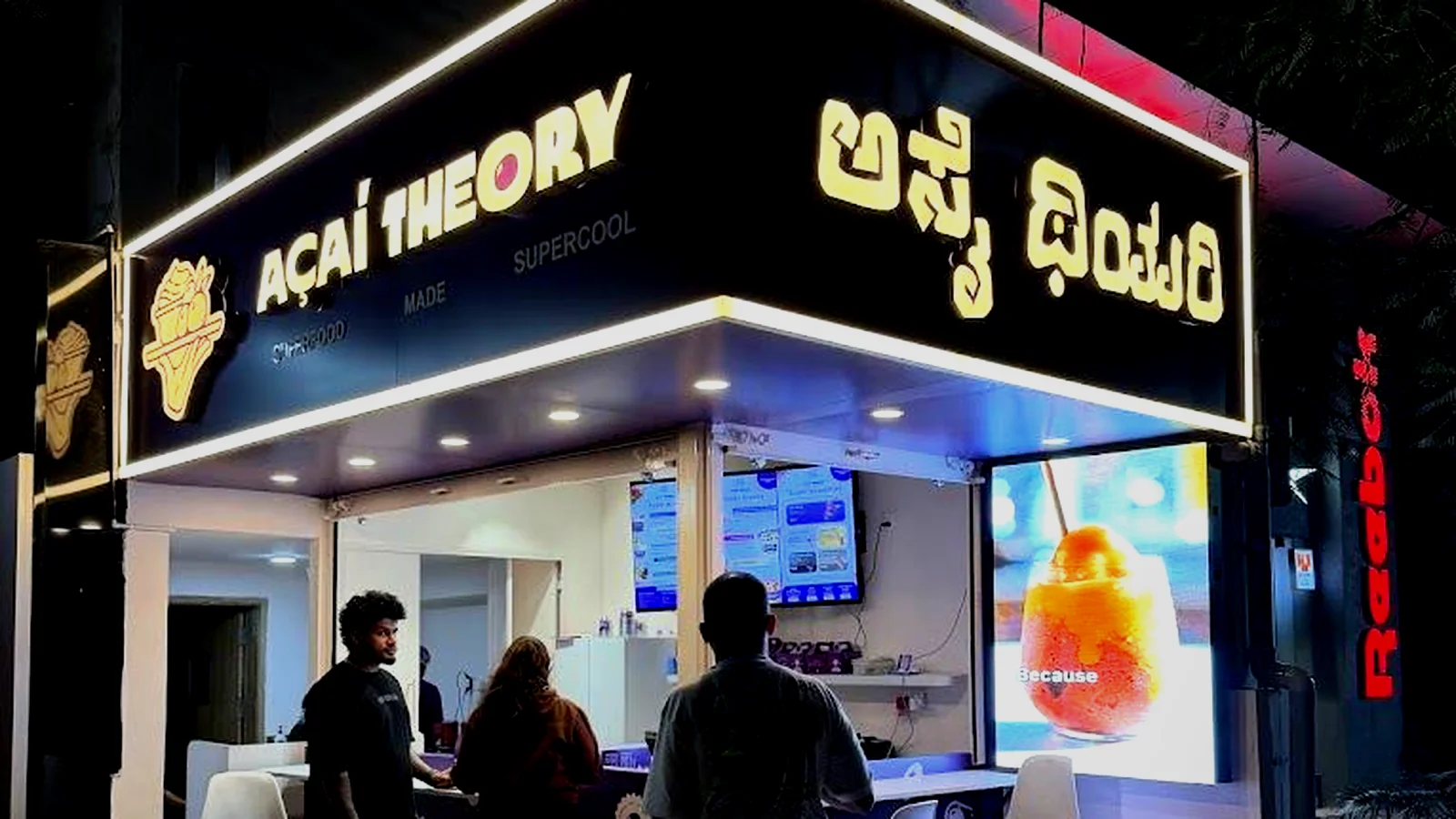
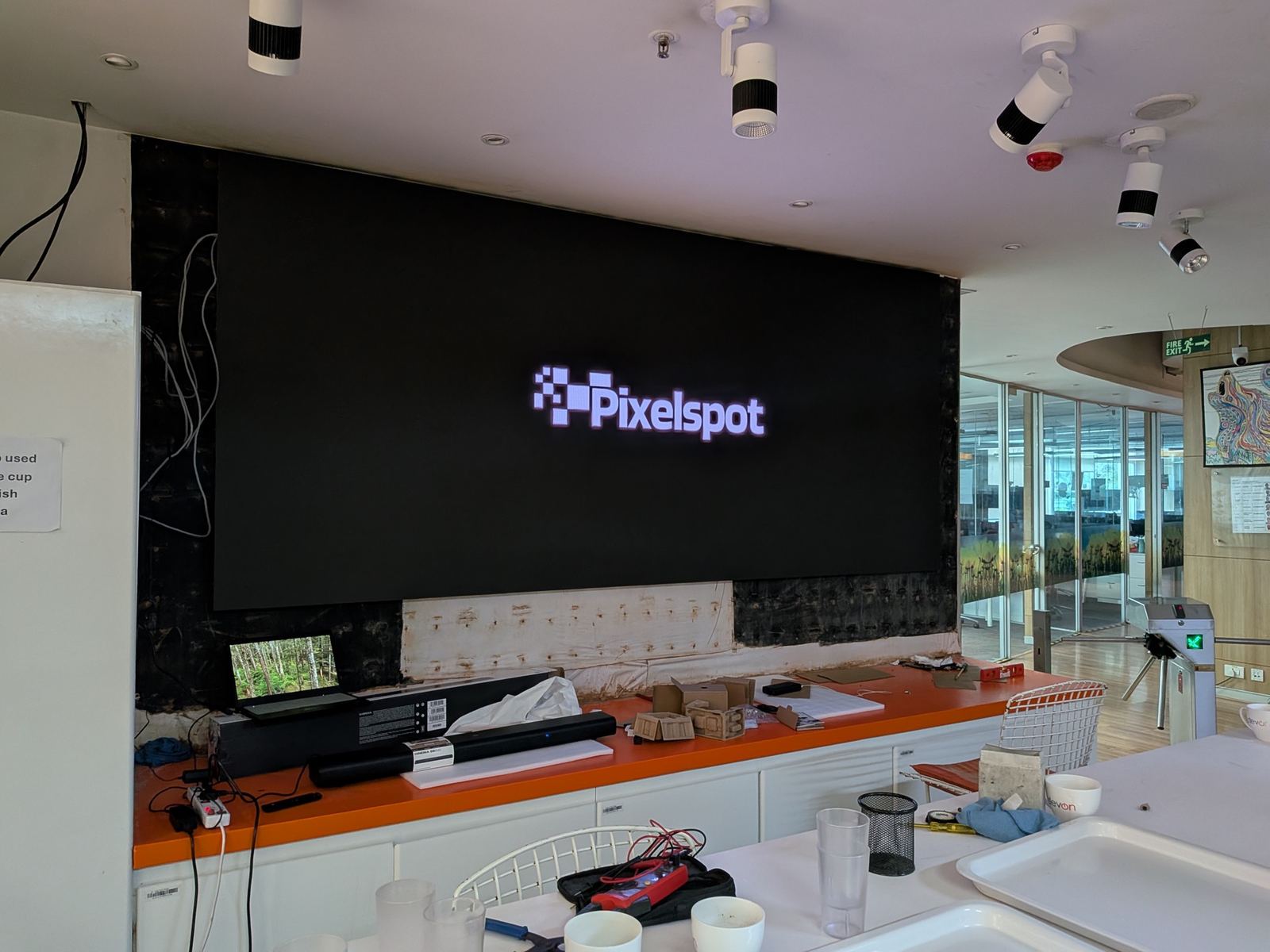
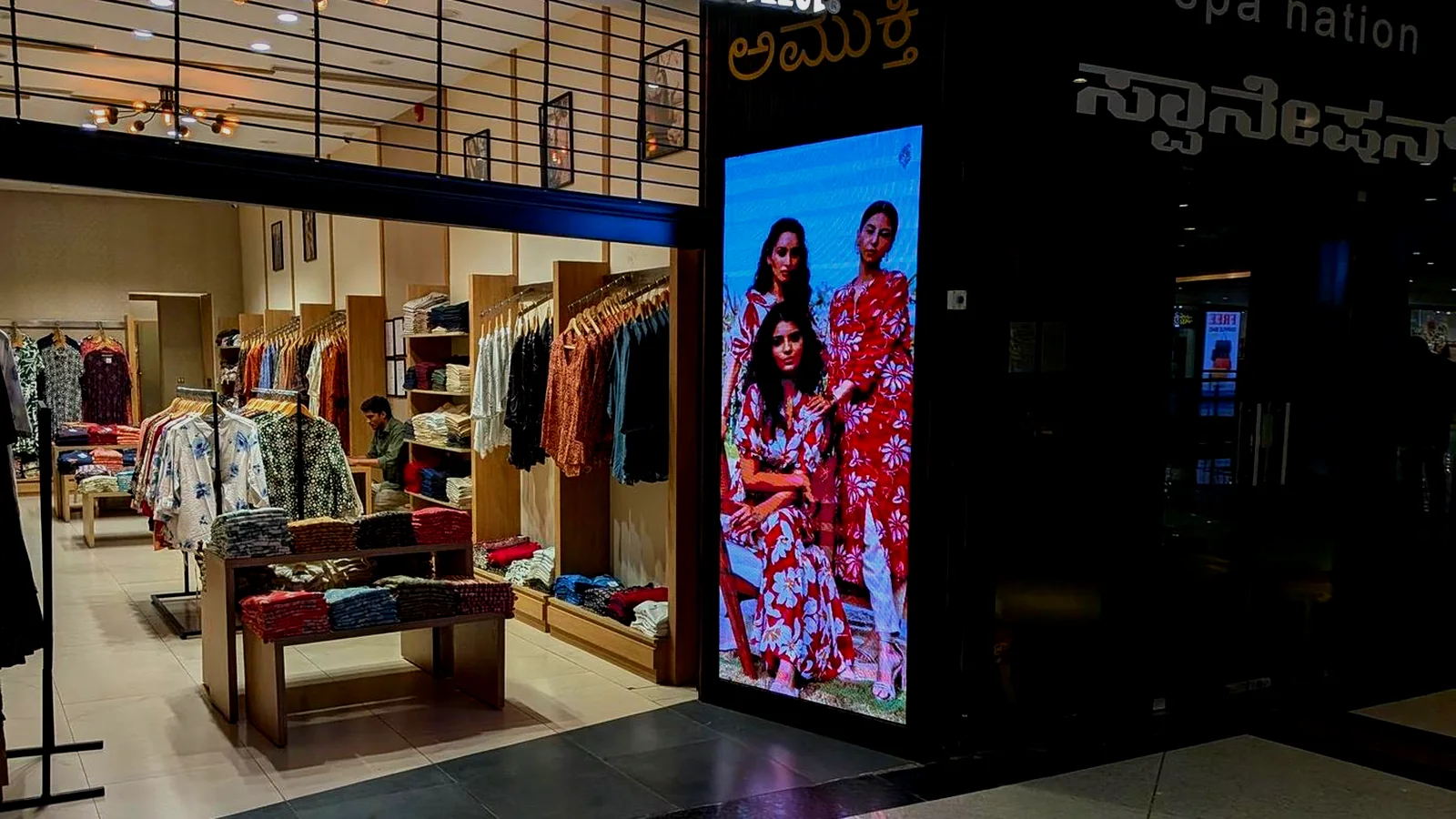
PixelSpot has installed 65+ walls and is rated 5.0 on Google from 15 reviews. Want to see one first? Visit our Bengaluru showroom or ask for a live video call from the factory floor.
More from PixelSpot.
Questions buyers ask.
What is the difference between an LED video wall and an LCD video wall?
An LCD video wall is a grid of panels with bezel lines of 0.9 to 3.5 mm between them. An LED video wall is built from modules that sit edge to edge, so the picture is seamless, any size or shape, bright enough for daylight, and a fault means swapping one module, not a whole panel.
Which pixel pitch do I need?
Measure the distance from the screen to the nearest viewer. The closest comfortable distance in metres is roughly the pitch number, and the picture looks best from about twice that. So P2.5 suits viewers from about 2.5 m, P4 from about 4 m and P10 from about 10 m. Boardrooms under 2 m need P1.2 to P1.8; shopfronts read from the pavement usually take P3 or P4.
How bright should an LED video wall be?
Indoor PixelSpot walls go up to 600 nits and usually run at 30 to 50% in a lit room. Outdoor walls go up to 4,500 nits, which reads in daylight, and dim automatically after dark. A screen behind glass facing a bright street needs an outdoor-grade panel, not an indoor one.
What decides the price of an LED video wall?
The pixel pitch, the wall size, indoor or outdoor, the controller, the structure and site access. A finer pitch and an outdoor build cost more per square foot, and bigger walls cost less per square foot. Use the configurator to get your estimate in a minute; our team then calls you with the best price for your site.
How long does an LED video wall last?
The LED modules usually last 8 to 12 years before they fall to half brightness. Power supplies fail most often and are replaced on site. Moderate brightness, clean power and a yearly service keep a wall going 10 years and more.
What does the 2-year pixel-to-pixel onsite warranty cover?
It runs for 2 years from commissioning, and one dead, stuck or dim pixel is a valid claim. Modules, power supplies, receiving cards, the controller, cabinets and cabling are covered, repaired at your premises with no charge for parts, labour or travel.
Do you install LED video walls outside Bengaluru?
Yes. Our own crew installs across Karnataka, and walls are shipped by road from our Bengaluru factory and installed by the same crew in cities across India. Freight and crew travel are shown on the quote.
How long does it take from order to installation?
In Bengaluru, survey to handover is usually 5 to 7 business days. Outside Bengaluru, add the road freight time to your city; the production time is confirmed with your quote and the crew is booked for the day the crates arrive.
Can I rent an LED video wall from PixelSpot?
No, we don't rent LED walls. For a one-off event, an event-AV company that rents screens is the right call. If you will use a wall several days a month, owning one costs less over time, and that is what we build.
Plan your LED video wall.
Tell the configurator your size, pitch and site. You get an estimate in a minute, and our team calls you with the best price.