Industry guide
LED video walls for commercial buildings. Five spaces, five specs.
The lobby, the facade, the cafeteria, the lift lobby and the road frontage each need a different wall. Here is what each one should be, and what it costs.
A commercial building in Bengaluru has more places for an LED wall than most owners think: the lobby, the facade, the cafeteria, the lift lobbies and basement, and the road frontage that tenants would pay to be seen on. Each place wants a different pixel pitch, a different brightness and a different budget. The most common mistake is buying one specification for all of them.
The short version
- Lobby: indoor P1.8 to P2.5 at 800 to 1,200 nits. An 8 × 4 ft P2.5 wall is ₹1,86,000 + GST.
- Facade: outdoor IP65, P4 to P6, up to 6,500 nits in direct sun and dimmed hard at night. A 20 × 10 ft P4 wall is ₹10,90,500 + GST.
- Cafeteria and town hall: indoor P2.5 with an HDMI input. A 12 × 6 ft wall is ₹4,05,000 + GST.
- Wayfinding and parking: small, text-first screens, with sealed cabinets wherever there is dust or damp.
- Tenant advertising: a road-facing outdoor wall run like a small media property, with permissions checked first.
Why does each space need a different LED wall?
Three numbers decide every LED wall: how close the nearest viewer stands, how much light the wall competes with, and how many hours a day it runs. In a lobby, visitors stand 2 m away under indoor light. On a facade, drivers pass 20 m away in full sun. In a basement car park the light is poor, but the air is dusty and damp. No single product is right for all three.
| Space | Pitch | Brightness | Example wall, controller included |
|---|---|---|---|
| Lobby and reception | Indoor P1.8 to P2.5 | 800 to 1,200 nits | 10 × 6 ft P2.5: ₹3,42,000 + GST |
| Facade | Outdoor P4 to P6, IP65 | 5,500 to 6,500 nits, dimmed at night | 20 × 10 ft P4: ₹10,90,500 + GST |
| Cafeteria or town hall | Indoor P2.5 | 500 to 1,200 nits, by daylight | 12 × 6 ft P2.5: ₹4,05,000 + GST |
| Lift lobbies and wayfinding | Indoor P2.5 | 800 to 1,200 nits | 6 × 4 ft P2.5: ₹1,43,000 + GST |
| Road-facing advertising | Outdoor P4 or P5 | 5,500 to 6,500 nits | 16 × 9 ft P4: ₹7,94,500 + GST |
Installed, with controller, PixelOS and the 2-year onsite warranty. Structure for outdoor walls is quoted separately. Updated 29 September 2026.
The lobby: first impressions at two metres
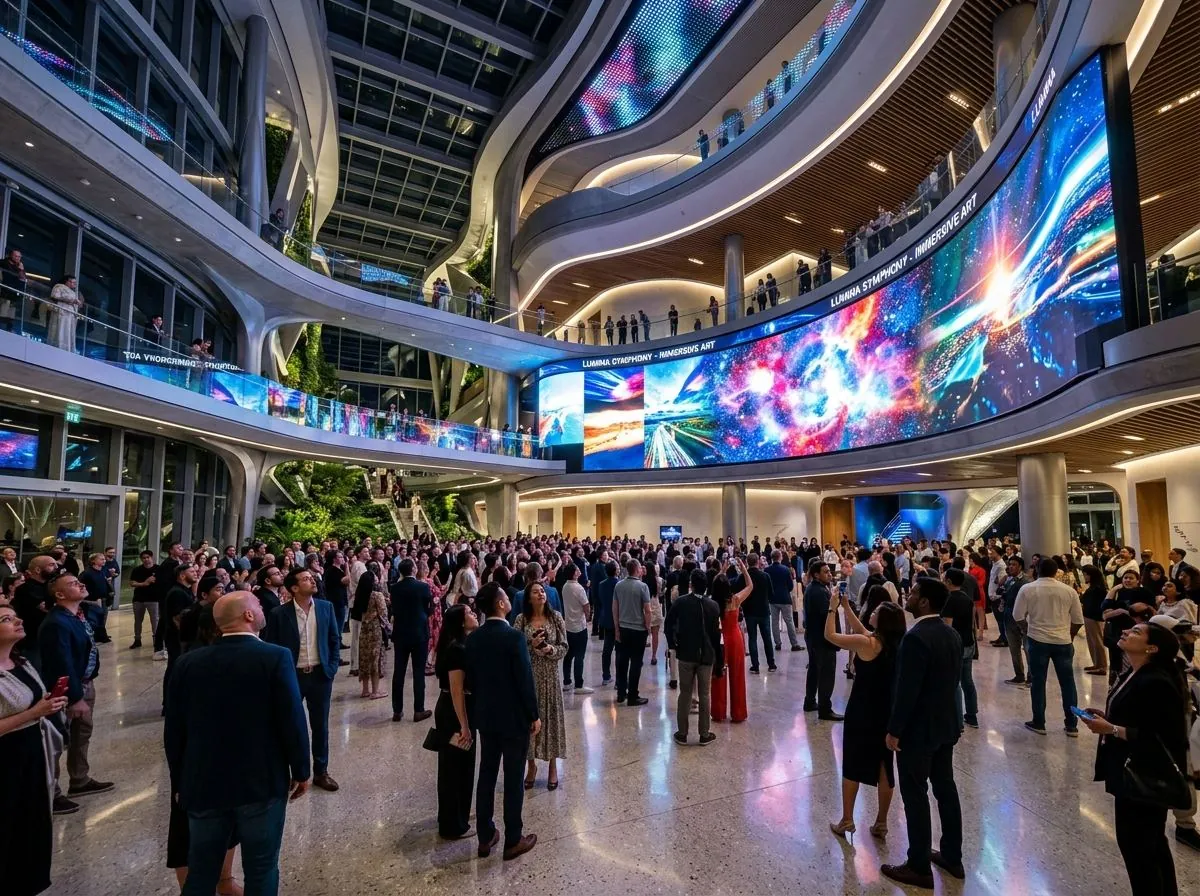
Visitors stand still at reception, often 2 to 3 m from the wall, so pitch matters more here than anywhere else in the building. P2.5 at ₹4,700 per sq ft + GST works when the nearest visitor is 2.5 m away. Step to P1.8 at ₹7,300 per sq ft + GST when the desk brings them closer. Choose front-service cabinets, so the wall sits flush with the stone and is serviced from the lobby side.
Our corporate lobby buying guide covers sightlines, welcome screens and content in detail, and the office lobby page lists sizes and prices.
The facade: bright by day, quiet after dark
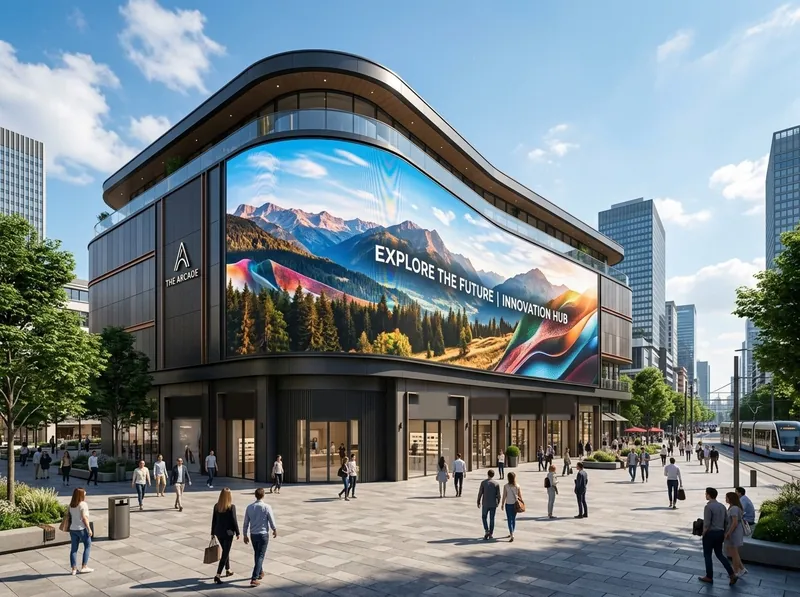
A facade wall faces Bengaluru sun and monsoon rain. It needs outdoor cabinets, IP65 at the front and IP54 at the rear, and brightness matched to its position: 3,500 to 5,000 nits if it is shaded or north-facing, 5,500 to 6,500 nits for direct sun. After dark it must dim hard. Above about 500 nits at night, a wall becomes glare for neighbours and drivers, which is why auto-dimming is standard on our outdoor walls.
Pitch follows the viewing distance. Pedestrians on a plaza 4 to 6 m away want outdoor P4 at ₹4,800 per sq ft + GST. A wall read from across the road can use P5 at ₹4,450 per sq ft + GST or P6 at ₹5,500 per sq ft + GST. Closer, finer outdoor walls use P3 at ₹6,950 per sq ft + GST. For very large, distant facades we also build P8 and P10, priced on request.
The steel structure, wind loading and cable routes are designed after the free site survey and quoted separately. Outdoor walls also need an earthed, IP65 distribution box within 3 m of the wall. Our guide to monsoon, power and GST for outdoor walls covers the rest, and the outdoor LED range lists every option.
Facade
Seen from the road. Quiet after dark.
A facade that dims itself at night keeps the neighbours on your side.
The cafeteria or town-hall wall
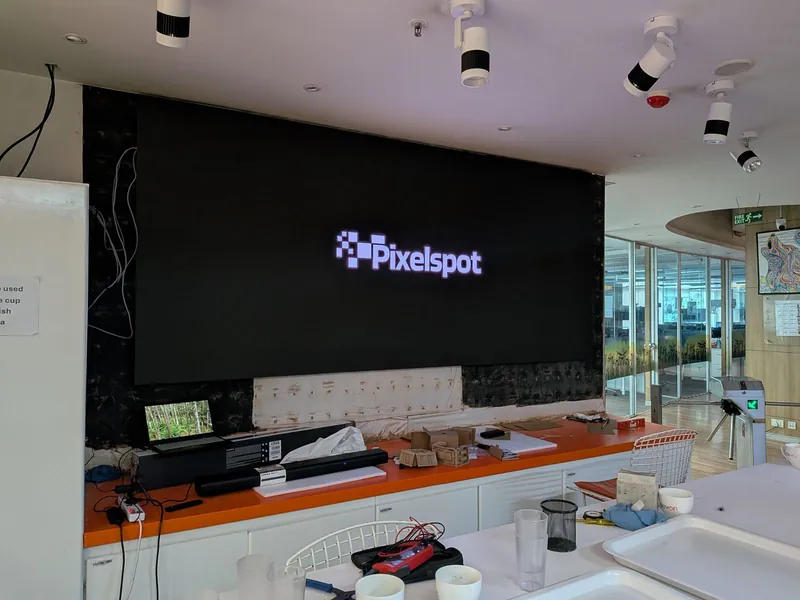
The cafeteria is where a company gathers: town halls, all-hands, festival days, a cricket final at lunch. One Bengaluru corporate office we worked with had tried a projector, which washed out under the skylights, and a grid of TVs, which put bezels through every slide. We replaced both with a wide indoor fine-pitch LED wall in the cafeteria, on front-service cabinets, installed in one working day. The corporate office case study tells the story.
For most cafeterias indoor P2.5 is right, because people sit 3 m and more away. Give the wall an HDMI input for the presenter’s laptop, and let PixelOS, our cloud CMS, run announcements and menus when nothing is being presented.
Lift lobbies, wayfinding and parking
Wayfinding screens are small and text-first: which tower, which floor, which tenant, where visitor parking is. Keep text large and high-contrast, and schedule content by time of day: the tenant directory in the morning, event notices in the afternoon, a dim evening loop at night. A 6 × 4 ft P2.5 wall at ₹1,43,000 + GST suits a lift lobby. For corridors and entrances, standees and smaller screens often fit better; see digital signage in Bengaluru.
Basements and semi-open parking are a special case. The light is low, but dust, exhaust fumes and monsoon damp are hard on unsealed electronics. Specify outdoor cabinets there, IP65 at the front and IP54 at the rear, even under a roof, and run them at low brightness. A 6 × 4 ft outdoor P4 wall is ₹1,46,000 + GST.
Tenant advertising: the building as a media owner
A road-facing wall on a busy stretch can carry paid slots for tenants and outside brands. That turns the wall into a small outdoor media property, with playlists scheduled by time of day in PixelOS. Ground-floor tenants often want their own screen too, facing the pavement.
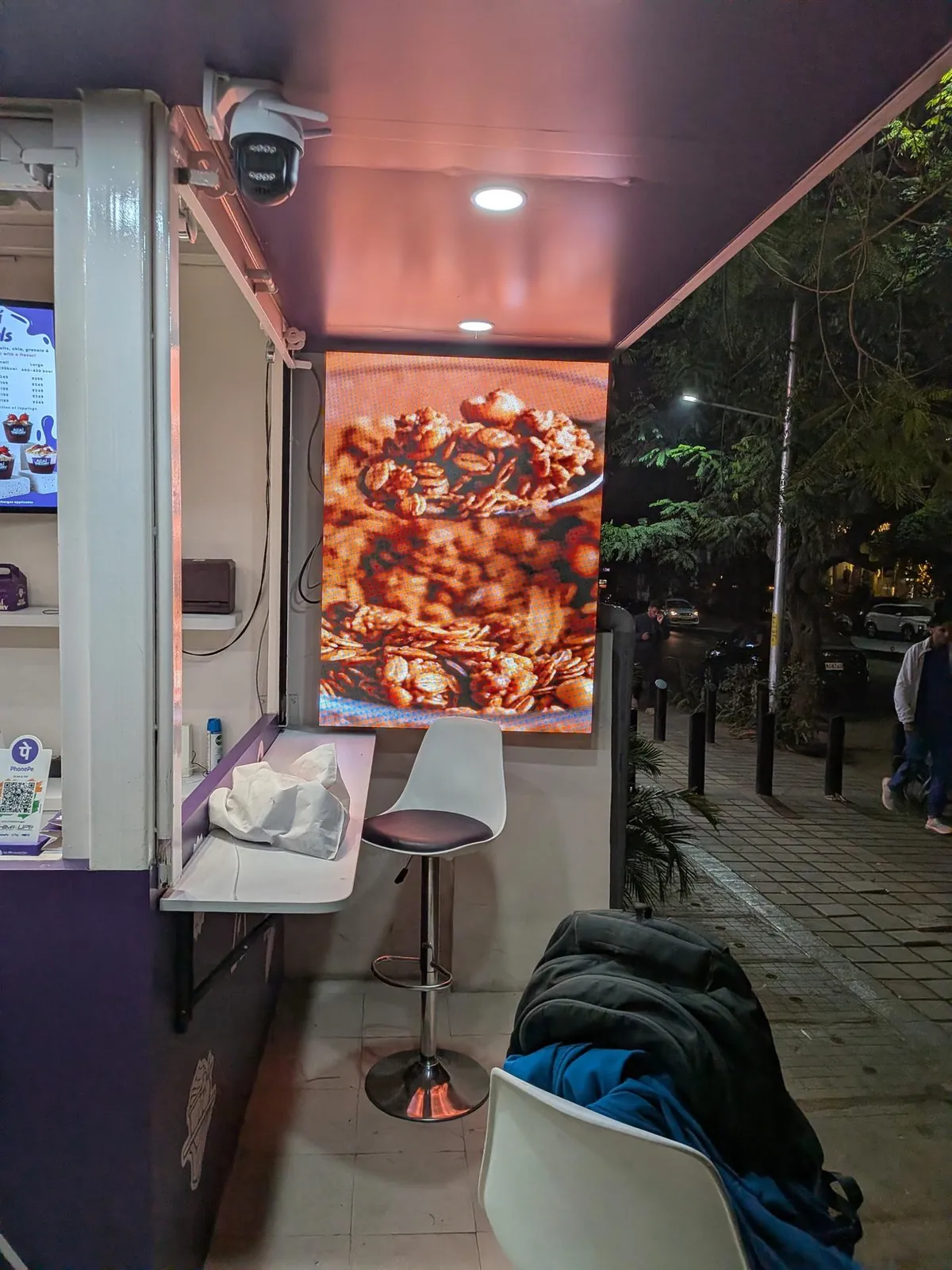
Two cautions before you build. First, outdoor advertising in Bengaluru needs the right permissions, and the rules change; confirm what your building may display before you size the wall. Second, do not buy on an imagined revenue figure. Work out slots, rates and occupancy from real conversations with tenants and brands first. Our article on LED walls as a DOOH revenue asset walks through that sum.
One building, one system
Buying several walls together has practical advantages. One survey covers every location. One PixelOS account runs every screen, so the facilities team schedules the lobby, cafeteria and lift lobbies from one phone. Spares come from matched production batches. And one warranty covers everything: our 2-year pixel-to-pixel onsite warranty, with a response within 24 hours in Bengaluru, extendable up to 5 years. The warranty page has the terms.
- Walk the building. Mark each candidate spot with its nearest viewer distance, its light level and its daily hours.
- Rank by impact. Lobby and facade first, then the cafeteria, then wayfinding.
- Survey once. We check structure and power at every location and send a 3D mockup of each wall in place.
- Phase the budget. Install in stages if you need to, on one PixelOS account from day one.
Every wall is assembled and burn-in tested at our Bengaluru facility in Jalahalli East before delivery, and serviced from the same workshop afterwards.
Where to go next
A building that plans its walls together ends up with five screens that each do one job well, instead of one expensive specification used everywhere. Every pitch and size is on the LED wall price guide.
Questions? Answers.
Which LED wall should a commercial building install first?
What pixel pitch does a building facade need?
Can one team manage every screen in the building?
Is GST charged on LED walls for commercial buildings?
See it running. Then decide.
Send your wall size on WhatsApp for a same-day price, or see indoor and outdoor walls running at our Jalahalli East experience centre in Bengaluru.
Prices are estimates: installed, controller extra, plus 18% GST. See every price