The question most buyers never ask until year two
Almost every LED wall enquiry we receive in Bengaluru starts with the same three questions: what pixel pitch, what brightness, what price. Those matter. But there is a fourth question that quietly determines your cost of ownership for the next seven to ten years, and it rarely comes up during the quotation stage: how will a technician physically reach a failed module?
An LED video wall is not a single screen. It is a grid of cabinets, and each cabinet holds several modules. Modules are field-replaceable by design. A dead pixel cluster, a failed receiving card, a power supply that gives up after a long summer — these are routine, expected events, not disasters. What turns a routine event into a two-day shutdown and a scaffolding bill is a wall that was installed without a serviceable access plan.
That plan comes down to one architectural choice made at the design stage: front service or rear service.
What front service actually means
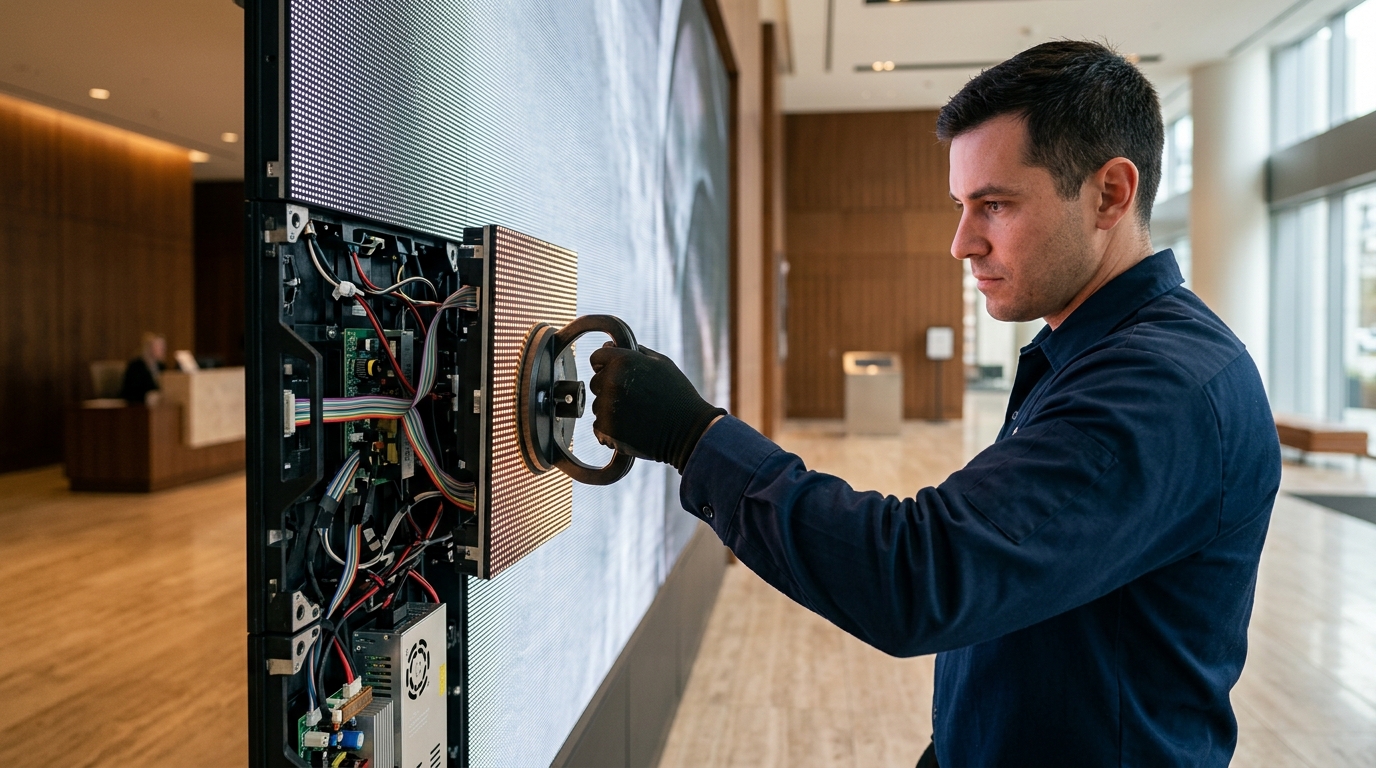
In a front-service design, modules and internal components are removed from the viewing side. The technician stands in front of the wall, uses a magnetic suction tool or a mechanical latch release, lifts the faulty module straight out, unplugs the connector, and slots in a replacement. On well-designed cabinets, power supplies and receiving cards are reachable from the same side once the module is out.
The advantage is obvious: zero rear clearance required. The wall can be mounted flush against a structural column, a lift lobby wall, a shopfront bulkhead, or a load-bearing masonry surface. For a lot of Indian commercial interiors, that is not a nice-to-have — it is the only way the screen fits at all.
The trade-offs are real, though, and any vendor who tells you there are none is selling, not advising:
- Front-service cabinets often carry a slightly deeper or heavier frame to accommodate the internal service geometry.
- Repeated front removal on very fine pitches demands careful technique; modules are handled from the LED-facing side, where the lamps are exposed.
- Magnet strength and module flatness matter enormously. Cheap cabinets develop visible seams over time as modules are pulled and re-seated.
- Front-service cabinets typically carry a price premium over the equivalent rear-service model.
Rear service: still the better engineering answer when you have the room
Rear service means the technician works from behind the wall, through a maintenance corridor, catwalk, or a hinged door in the supporting structure. Modules push out from the back, cables and receiving cards sit exposed and organised, and the LED face is never touched during maintenance.
Where you can accommodate it, rear service is generally the cleaner long-term arrangement. Nothing on the viewing face is disturbed, module flatness stays stable across years of servicing, and airflow behind the wall is usually better because the corridor doubles as a plenum. Large outdoor billboards, stadium perimeter and fascia screens, and purpose-built control rooms are almost always designed this way.
The catch is space. A usable service corridor needs genuine walking room plus safe access — typically around 800mm to 1m of clear depth, though you should confirm the exact figure against the cabinet series you are buying. On an outdoor pole-mounted DOOH screen, that corridor also has to be weatherproofed, ladder-accessible and safe for a technician working at height in Bengaluru's monsoon.
Five Indian site conditions that make the decision for you
In practice, the choice is rarely philosophical. It is dictated by the building. These are the situations we run into most often during site surveys:
- Retail inside a mall. Leased shopfront depth is precious and the landlord will not give you a metre of it. Front service, almost always.
- Corporate lobby feature walls. The wall is usually a finished architectural surface — stone cladding, ACP, gypsum with a designer finish. Cutting a service door behind it is expensive and the interior designer will resist it. Front service.
- Control rooms and NOCs. These are often purpose-built with a technical corridor already in the layout. Rear service, and it is worth insisting on it — control room walls run 24/7 and get serviced more often than any other category.
- Outdoor DOOH on a building facade. If the screen is bolted onto an existing parapet or wall face with no cavity, front service is your only realistic option. Free-standing hoardings with a steel frame behind them can go either way.
- Rental and event walls. Rental cabinets are their own category — light, quick-lock, curve-capable — and are typically serviced front and rear depending on the series. If you are buying for the rental business, prioritise cabinet weight and lock speed alongside serviceability.
Outdoor adds a monsoon variable
For outdoor screens, service access is not just about convenience — it is about ingress protection. Every time a module comes off a front-service outdoor cabinet, the gasket seal at that joint is broken and remade. If the module frames are poorly machined or the gasket material is low grade, you get progressive water ingress at exactly the points you serviced most often. This is one of the sharpest differences between genuine branded cabinets and white-label imports, and it does not show up in a spec sheet comparison.
It is also why we only fit genuine branded modules from manufacturers like Qiangli and Hikvision on outdoor work. The gasket, the frame casting tolerance, the connector quality and the power supply derating behaviour under Indian summer ambient temperatures are the parts of the product you cannot inspect at handover — you only discover them in year three.
Questions to put to your vendor before you sign
Whichever way your site pushes you, get these answers in writing:
- Which cabinet series, and is it front-service, rear-service, or dual-service? Ask for the manufacturer datasheet, not a reseller's brochure.
- What is the exact cabinet depth and the minimum clearance required for service, including tool swing?
- Are the power supply and receiving card accessible from the same side as the module, or does one require rear access even on a front-service cabinet? This trips people up.
- What spare module and power supply stock is being held locally in India for this series, and for how many years?
- What is the module replacement procedure and typical turnaround under the AMC?
- For outdoor: what is the IP rating on the front and rear faces separately, and what happens to it after repeated servicing?
Design it before you build the wall behind it
The cheapest time to solve service access is on a drawing. The most expensive time is after the false ceiling is up, the stone cladding is fixed, and a module in the third row has gone dark during a client visit.
At PixelSpot we settle this during the site survey, before the quotation is finalised — cabinet series, mounting method, clearance, spares plan and AMC scope, all agreed on paper. Combined with A-grade genuine branded modules, 3840Hz to 7680Hz refresh rates for clean on-camera performance, and PixelOS for content scheduling and remote health monitoring, the goal is a wall that stays uniform and bright long after the installation photos are taken.
Because the wall you buy is easy. The wall you can still maintain in year six is the one worth paying for.