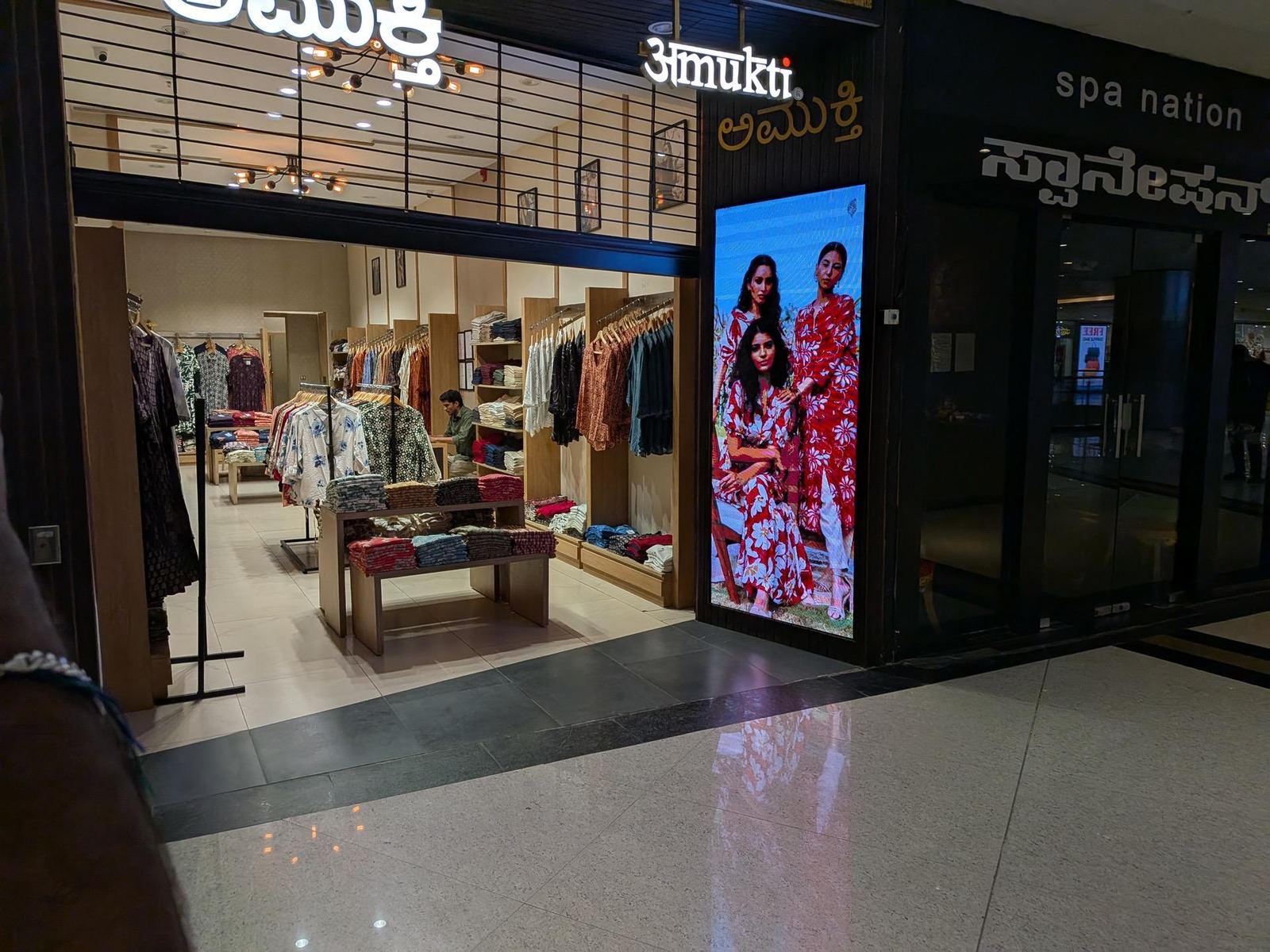
A jewellery showroom is the hardest room in Indian retail to put a screen into. Everything inside it is already engineered for light — 4000K spotlights over the counters, mirror-polished flooring, glass display cases, and a customer standing 1.2 metres away comparing the yellow of a 22K bangle on the screen with the yellow of the one in her hand. If those two yellows do not match, your ₹30 lakh interior suddenly looks like it is advertising brass. That single problem — colour fidelity at close viewing distance — drives almost every specification decision in a jewellery LED wall, and it is the reason a generic "retail LED screen" quote usually disappoints. Here is how to buy it properly.
First decide which of the three screens you are actually buying
Most jewellery retailers we work with in Bengaluru, Hubballi and Chennai end up with more than one display, and each has completely different specs. Do not let a vendor quote one panel type for all three.
1. The facade / above-entrance screen
Seen from across the road, 8–25 metres away, competing with daylight and street lighting. This is your footfall machine — festival offers, Akshaya Tritiya campaigns, gold rate tickers. Viewing distance is long, so pixel pitch can be relaxed (P4 to P6 indoor-facing-out, or a proper outdoor IP65 cabinet at P6–P8 if it is genuinely exposed). Brightness matters far more than resolution here.
2. The in-store hero wall
Usually behind the main counter or on the feature wall opposite the entrance, viewed from 2–5 metres. This runs bridal collection films, artisan close-ups, brand campaigns. P1.8 to P2.5 is the sweet spot. This is the screen where colour accuracy is non-negotiable.
3. The counter-level or pillar display
Viewed from under 1.5 metres while a customer is seated. Anything coarser than P1.5 will show visible pixel structure and kill the premium feel. Small area, high impact — often just 1.2m x 0.7m.
Pixel pitch vs viewing distance: the number that decides everything
The working rule in the industry is that minimum comfortable viewing distance in metres is roughly equal to the pixel pitch in millimetres. A P2.5 panel looks clean from 2.5 m and beyond; walk to 1 m and you start seeing the dots. Jewellery customers always walk closer than you expect.
| Pixel pitch | Comfortable viewing from | Best use in a jewellery showroom |
|---|---|---|
| P1.2 – P1.5 | 1.2 – 1.5 m | Counter-side panels, seating-area displays, VIP lounge |
| P1.8 | ~1.8 m | Hero wall behind main counter in compact showrooms |
| P2.5 | ~2.5 m | Feature wall in a 1,500+ sq ft floor, staircase landing |
| P3 – P4 | 3 – 4 m | Double-height atrium wall, first-floor bridal section |
| P4 – P6 (high-brightness) | 6 m+ | Facade above entrance, glass-front internal signage |
| P6 – P8 outdoor IP65 | 8 m+ | Fully exposed exterior board facing the main road |
When you search for LED video wall price, remember that cost scales with pixel density, not just area. A P1.5 wall of the same size as a P3 wall carries roughly four times the LEDs. That is why choosing the pitch based on honest viewing distance — not on "give me the sharpest" — is the single biggest lever on your budget. Live, transparent pricing for each pitch is published on pixelspot.in so you can model the trade-off yourself before anyone visits.
The colour specs that actually make gold look like gold
Ask for these on the quotation. If a supplier cannot answer them, they are reselling whatever cabinet landed cheapest that month.
- Colour temperature calibration: Your showroom lighting is probably 3500K–4200K to flatter gold. A screen running at factory-default 6500K will look blue-white next to it and make gold look pale. Insist the wall is calibrated on site to match your ambient lighting, and that the CMS lets you re-adjust seasonally.
- Brightness with dimming: Indoor walls should be capable of 800–1200 nits but must run at 250–400 nits in a jewellery interior. Over-bright screens cause glare on glass cases and make customers squint at your merchandise. Automatic brightness control and 16-bit greyscale at low brightness prevent the banding you see on cheap panels when they are dimmed.
- Refresh rate 3840Hz or higher: Jewellery is the most photographed retail category in India. Every customer, every influencer shoot and every wedding-season reel will point a phone at your wall. Below 1920Hz you will get scan lines in every video. This is not optional.
- Contrast and black level: Black-body masking on the LED package makes diamonds pop against dark backgrounds. Ask for the module datasheet — Hikvision and Qiangli modules used on PixelSpot builds specify this.
- Greyscale at low brightness: Gold gradients on a jewellery close-up are subtle. Poor greyscale turns them into flat blobs. Ask to see a gold-heavy test clip at your intended brightness before signing.
Physical realities in an Indian jewellery showroom
Service access
Jewellery interiors are dense — the wall behind the main counter usually has a strong room, a services duct or a structural column right behind it. If you cannot get 600–800 mm of rear walkway, you need front-serviceable panels where modules and power supplies are pulled from the front with a magnetic tool. Discovering this after installation means dismantling millwork to change a ₹2,000 module.
Heat and AC load
A 6 sq m indoor wall running at showroom brightness typically draws 1.5–2.5 kW average. That heat lands in a space where staff sit for nine hours. Plan an extra cassette AC or at least check your existing tonnage. Also confirm the panel's average vs peak power draw — quotes that only mention peak are hiding the electricity story.
Security and safety
Jewellery showrooms have the strictest fire and insurance scrutiny of any retail format. Ask for the power supply certification, flame-retardant cabinet rating, and confirm that the receiving card and hub board are not generic no-name units. A short circuit in a cheap driver behind a false ceiling is a genuinely serious risk in a store full of textiles and display velvet.
Content: what actually moves gold off the counter
- Live gold and silver rates, auto-updated through the CMS. Customers photograph this daily; it builds trust and repeat visits.
- Collection films at human scale. A necklace shot at 1:1 size on a P1.8 wall is more persuasive than any poster. Shoot on a plain dark background at your own lighting temperature.
- Scheme and EMI explainers — 11-month gold savings plans convert far better when explained visually while the customer waits.
- Occasion scheduling. Bridal from October to February, Akshaya Tritiya blocks in April–May, Dhanteras countdowns. PixelOS lets you schedule these weeks ahead so the store manager is not editing content on a festival morning.
- Silence by default. No audio on the sales floor. Sound competes with your sales staff, who are your actual conversion engine.
Pre-purchase checklist
- Measured viewing distance from the nearest customer standing position — not from the door
- Wall load-bearing check and structural drawing, especially for first-floor mezzanines
- Front-service vs rear-service decided by actual rear clearance
- Dedicated power point with earthing and stabiliser, plus UPS if you display live rates
- Refresh rate 3840Hz minimum, confirmed in writing
- On-site colour calibration to your showroom lighting included in scope
- Spare module and spare power supply included in the handover kit
- Warranty terms in writing — PixelSpot ships a 2-year pixel-to-pixel warranty and free installation as standard
- CMS access for your marketing team, not locked to the vendor
Get a spec, not a guess
Send us your floor plan or even a phone photo of the wall with a measuring tape in frame, and we will come back with the right pixel pitch, exact cabinet layout, power draw and a factory-direct price from our Bengaluru unit. Message PixelSpot on WhatsApp for a quote, or check live pricing for every pitch on pixelspot.in before you talk to anyone.