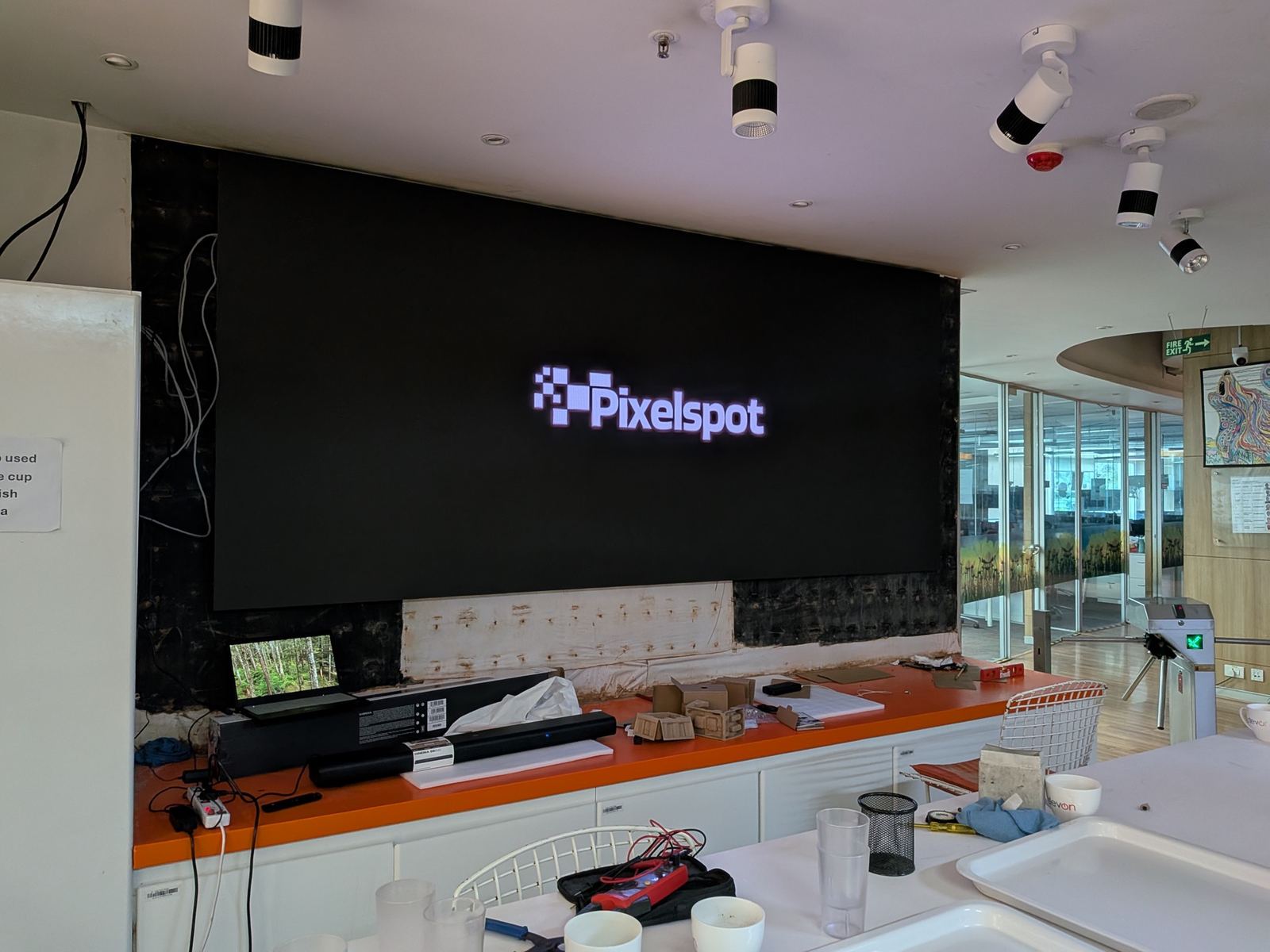
Most of the faults we are called to fix on LED walls in Bengaluru were installed badly, not built badly: a frame hung off plasterboard, a wall fed from a shared 6 A socket, receiving cards mapped by trial and error, no earth at all. This page is the installation process PixelSpot follows on every wall, from the first site survey to the PixelOS handover, so you know what should happen at your site and what to have ready. The crew that turns up is ours, on our payroll, trained at our Bengaluru factory. We have never subcontracted an installation since we started in 2022.
What LED wall installation covers at PixelSpot
- Free site survey with laser measurement, a check of the wall material (RCC, brick, ACP cladding or gypsum partition), a photo of your distribution board and the cable route from it to the wall.
- 3D mockup of the wall in your actual shopfront, lobby or hall, sent the same day as the survey.
- MS frame fabricated at our factory from box-section steel to the surveyed dimensions, powder-coated, with the cabinet hanging points pre-drilled.
- Cabinets assembled and burn-in tested at the factory before dispatch, with modules from a single batch so colour stays uniform.
- Anchoring and mounting: anchor bolts into the structure, frame plumbed and levelled, cabinets hung and locked.
- Internal power distribution, data cabling, NovaStar controller and receiving-card configuration.
- Calibration, PixelOS registration, your first content loaded, and a training session for whoever will run the wall.
- 5% spare modules and the 2-year pixel-to-pixel onsite warranty on every wall.
Three things are deliberately outside the installation price, and we tell you on the quote: the mains cable from your distribution board to the wall point and any BESCOM load enhancement (your licensed electrical contractor does this to our specification), civil work such as chasing, cutting a false ceiling or removing cladding, and scaffolding for walls whose top edge sits above 4 metres. Landlord, mall and BBMP approvals are yours to obtain; we supply the drawings and load calculations they ask for.
When a professional installation is the right choice
A permanent wall in a shop, office, temple, showroom, restaurant or function hall should be installed by the people who built it. That is the whole page. But there are three cases where we will steer you elsewhere at the survey:
- A campaign or event that runs for days, not years. A rental wall on a ground-stacked truss makes more sense than anchoring a frame into your wall for a fortnight.
- A viewing distance under 2 metres in a small room. Under about 30 sq ft of screen, a 98-inch LED TV (roughly 7 × 4 ft) often costs less than a fine-pitch P1.8 wall and needs no frame.
- Panels bought online, an electrician hired to hang them. We see the result on repair calls: cabinets from two batches that show as a colour patch, receiving cards mapped wrong so the picture is scrambled at the seams, no spare modules, no one to call. The saving on labour is gone at the first fault.
If you are still weighing a wall against a projector, the numbers are in LED wall vs projector. The corporate office case study is the usual outcome: a projector that washed out under skylights, replaced by a fine-pitch wall built into the existing recess in one working day.
The spec decisions we settle at the survey
| Decision | What we measure | Typical answer in Bengaluru |
|---|---|---|
| Pixel pitch | Nearest seat or standing position | P1.8 for boardrooms under 2 m; P2.5 for shops, lobbies and offices at 2 to 5 m; P3 to P4 for a shopfront read from the pavement; P6 to P10 for a facade read from the road. See the pixel pitch guide. |
| Brightness | Ambient light, window orientation, time of day the wall matters | 600 to 1,000 nits indoor, then run at 30 to 50%; 5,000 to 6,500 nits outdoor. A west-facing shopfront needs the top of the outdoor range. |
| IP rating | Rain, dust, kitchens, coastal air | IP65 front and rear for anything outdoors or in an open corridor. Indoor cabinets are not sealed; we keep them away from kitchen exhausts. |
| Cabinet type | Mounting depth, service access, wall material | Die-cast aluminium 640 × 480 mm front-service cabinets for indoor walls flush against masonry; rear-service iron cabinets outdoors where a catwalk or gap exists behind. |
| Size and resolution | Cabinet multiples, aspect ratio of your content | A nominal 10 × 6 ft P2.5 wall is 5 cabinets by 4: 3,200 × 1,920 mm and 1,280 × 768 pixels, close enough to 720p that video scales cleanly. |
| Controller | Live inputs, scheduling, remote monitoring | NovaStar sending card with HDMI for laptops and cameras; a standalone player where the wall only runs scheduled signage. PixelOS manages both. |
Day by day: the 5 to 7 business day timeline
| Day | On our side | On your side |
|---|---|---|
| Day 0 | Site survey, laser measurement, distribution board photographed, 3D mockup sent | Show us the wall, the power source and where the operator will sit |
| Day 1 | Fixed quote and mounting drawing; fabrication starts on approval | Approve the quote; start any landlord or mall paperwork |
| Days 1 to 4 | MS frame cut, welded and powder-coated; cabinets assembled, burn-in tested, receiving cards pre-mapped at the factory | Electrician installs the power point and earth to our specification; cladding or false ceiling cut to the marked outline |
| Day 4 | Site readiness check on WhatsApp: photo of the finished power point and cleared wall | Confirm access hours (closed hours for shops, before opening for malls) |
| Day 5 | Anchors drilled, frame mounted and levelled, cabinets hung and locked, internal power and data cabling | Access for the crew and a place to stage cabinets |
| Day 6 | Controller commissioned, mapping verified, colour and brightness calibration, PixelOS registration | LAN or Wi-Fi credentials for the controller |
| Day 7 | Content loaded, operator training, warranty card and spare modules handed over | Nominate the person who will run the wall |
Small walls compress this: the Acai Theory shopfront wall in Indiranagar was mounted and commissioned within a day, during closed hours, with only the power point and a LAN cable at the customer's end. A 20 × 10 ft outdoor facade with a fresh BESCOM connection stretches it, mostly on the paperwork rather than the work.
Wall load, anchors and the frame
A finished indoor wall weighs roughly 3 to 4 kg per sq ft including the frame, so a 10 × 6 ft wall is 200 to 240 kg hanging off the anchors. Outdoor iron-cabinet walls run 5 to 6 kg per sq ft and carry wind load on top. The survey decides how that load reaches the structure:
- RCC wall or column: M10 or M12 expansion anchors straight into the concrete, spaced along the frame's horizontal members.
- Brick or block: chemical anchors with a resin capsule, because expansion anchors crack older mortar joints.
- Gypsum, plasterboard or ACP partition: never anchored to the board. The frame is tied back through the partition to the slab or columns behind it, or built floor-standing with adjustable feet so the partition only guides alignment.
- Recess, pillar or shopfront opening: the frame is built to the opening rather than to a flat wall. The Amukti store display was framed into an entrance pillar so no floor space was lost; the corporate office wall was built to the exact recess.
- Facade: a cantilevered MS frame tied to the building's columns, with the tie-back points and wind-load calculation on the drawing your landlord or BBMP will ask for.
The frame is plumbed with a laser line and levelled to within a couple of millimetres across the full width. That tolerance is what makes cabinet seams disappear; a frame that is out by 5 mm shows as a visible line in every dark scene for the life of the wall.
Power point, earthing and the BESCOM check
Size the supply for the peak, not the average. An indoor P2.5 wall averages 14 to 23 W per sq ft on normal content and peaks at 46 to 65 W per sq ft on full white, so a 10 × 6 ft wall can pull 3.9 kW for a moment even though it averages about 1 kW. The full tables are on the power consumption page. What we specify to your electrician:
- A dedicated 16 A point for indoor walls up to about 8 × 6 ft; a dedicated 20 A single-phase line for 10 × 6 ft; larger indoor and all outdoor walls split across circuits from their own MCBs.
- An RCCB on the wall's circuit and a proper earth, tested, never the neutral. Most receiving-card and power-supply failures we repair trace back to a floating earth or a voltage sag.
- A stabiliser or online UPS where the site has voltage swings, common in older Bengaluru buildings on shared transformers. It is the cheapest life extension a wall can have; see what wears out first.
- For a wall above about 10 kW peak, typically a 20 × 10 ft outdoor facade, a three-phase feed and a check of the sanctioned load on your BESCOM connection before we fabricate. An enhancement application takes longer than the wall does.
Cable routing, controller commissioning and calibration
Inside the wall, power runs in daisy chains of cabinets, each chain sized so it never exceeds the breaker feeding it, and data runs on CAT6 from the controller to the first cabinet and loops cabinet to cabinet. From the controller to your source we run HDMI, or a longer fibre or CAT6 extender where the operator sits more than 15 metres away. On commissioning day the NovaStar sending card is configured for the wall's exact pixel count, each receiving card is mapped to its physical position and we confirm the mapping with a test pattern before any content goes up. Calibration then covers three things: brightness matched across cabinets, colour temperature set to suit the room and your content, and a brightness schedule in PixelOS so the wall drops to 30 to 50% indoors and dims after dark outdoors, which is where most of a wall's lifespan is won.
The PixelOS handover
On the last day you get the wall registered on PixelOS cloud CMS with your login, your first content scheduled by time of day, a short training session for the person who will run it (usually 20 minutes from a phone), the warranty card, the 5% spare modules in a labelled box, and the mounting drawing and electrical specification on file for your landlord, auditor or the next tenant. From then on, remote monitoring through PixelOS shows us a failed power supply or receiving card before you notice a dark block, and any engineer visit inside Bengaluru is within 24 hours.
What you need to have ready
- The power point and earth installed at the wall position, to the specification on our quote.
- The wall cleared, and any cladding, signage or false ceiling cut back to the outline we marked at the survey.
- A LAN point or Wi-Fi for the controller so PixelOS can reach it.
- Access hours agreed: shops usually prefer closed hours, malls require work before opening, offices a weekend.
- The landlord, mall or society approval where one is needed, using our drawings.
- Someone nominated to receive the training and the spare modules.
Facades, landlords and BBMP
An indoor wall inside your own premises needs no municipal permission. A mall or a landlord will usually want to approve the mounting and power drawings, which we provide with the quote. A shopfront or facade wall that faces the road is different: it sits under BBMP's signage rules, and the rules distinguish between your own branding on your own premises and paid third-party advertising, which is licensed as a hoarding. If you plan to sell ad slots on the screen, read the LED hoarding page first and budget time for the licence. In all cases we supply the elevation drawing, the frame tie-back detail and the load calculation, and we set a night-time brightness limit in PixelOS so a road-facing wall does not draw complaints from the flats opposite.
Price with installation, Bengaluru 2026
PixelSpot's per-square-foot price includes the frame, mounting, internal power distribution, cabling, commissioning, calibration and handover. Indoor P2.5 starts at ₹5,500 per sq ft and outdoor P4 at ₹5,000 per sq ft, before GST. The 10 × 6 ft wall most Bengaluru shops and offices buy therefore lands at about ₹3.3 lakh before GST, installed.
| Wall | Pitch | Area | Installed price before GST |
|---|---|---|---|
| 6 × 4 ft, reception or counter | P2.5 indoor | 24 sq ft | from ₹1.32 lakh |
| 8 × 4 ft, showroom or restaurant | P2.5 indoor | 32 sq ft | from ₹1.76 lakh |
| 10 × 6 ft, office or shop | P2.5 indoor | 60 sq ft | from ₹3.3 lakh |
| 12 × 8 ft, hall or auditorium | P2.5 indoor | 96 sq ft | from ₹5.28 lakh |
| 10 × 6 ft, shopfront | P4 outdoor | 60 sq ft | from ₹3 lakh |
What moves the number on a real quote: a floor-standing or cantilevered frame instead of a flat wall mount, scaffolding above 4 metres, a curved or ceiling-hung wall, a cable run beyond 15 metres to the operator, and night work. Coarser outdoor pitches cost less per sq ft and finer indoor pitches more; the full ladder is on the LED wall price guide, and the configurator gives a GST-inclusive figure for your exact size in 60 seconds.
Outside Bengaluru: Karnataka districts and the Hosur border
The same crew installs across every Karnataka district: Mysuru, Mangaluru, Hubballi-Dharwad, Belagavi, Kalaburagi, Shivamogga, Tumakuru and the rest. The process is identical; the timeline gains a day or two for travel and the survey is usually combined with the install visit after a video survey on WhatsApp. Hosur and Krishnagiri, 40 to 90 km down the highway in Tamil Nadu, are the one border extension we take on because they are closer than half of Karnataka. We do not install beyond that, because we do not subcontract, and a warranty is only worth what the crew behind it can reach. Within the city, LED wall Bangalore covers area-by-area work from Indiranagar to Whitefield to Jayanagar.
Three installations you can look at
- Acai Theory, Indiranagar: P2.5 outdoor IP65 panels in a shopfront opening facing afternoon sun, frame fabricated off-site, installed and commissioned within a day during closed hours.
- Amukti store, Bengaluru mall: portrait fine-pitch display framed into the entrance pillar, mall approval for power and mounting, installed before opening hours and handed over with content loaded.
- Corporate office cafeteria: projector replaced by a seamless fine-pitch wall built to the existing recess, installation, calibration and facilities-team handover in one working day.
Book a survey: WhatsApp a photo of the wall and its rough size to +91 72048 08334, or start with the 60-second configurator. Site survey and 3D mockup are free across Bengaluru.
Need Help Choosing the Right LED Display?
Get a free consultation and instant quote from PixelSpot experts.
Get Free Quote →