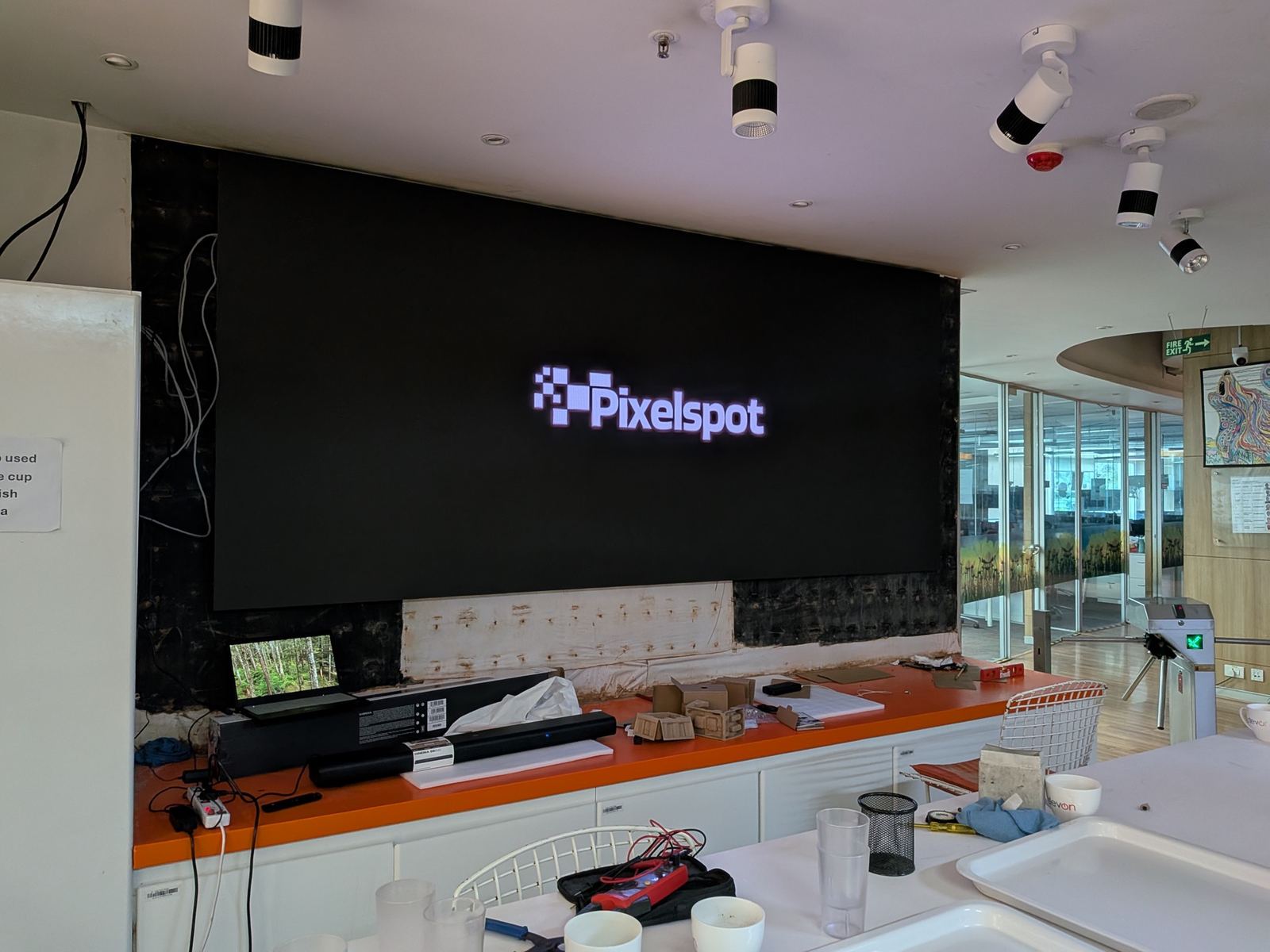
An LED video wall is bought once and lived with for eight to twelve years, yet most buyers compare quotes for about twenty minutes. The quotes do not line up: one is per piece, one is per square foot, one is for a "102-inch display", one is for a 10 by 6 ft wall, and none of them say who will come when a power supply dies in month fourteen. This guide is the checklist PixelSpot uses on its own walls, written for someone signing a purchase order for the first time. We have built and installed LED walls from our own factory in Bengaluru since 2022, more than 500 of them, so the numbers below are the ones we quote, not a survey of the market.
Is an LED wall the right purchase at all?
Not always. The honest fork is:
- Buy a commercial TV if you need one screen up to about 85 inches, viewed from 2 to 4 metres, in a room where you control the lights. It costs a fraction of an LED wall and needs no structure.
- Buy an LCD video wall only if you must read 4K-sharp text from within a metre and can live with bezels. For everything else the seven-year maths in LED vs LCD video wall favours LED.
- Keep the projector if the room can be darkened on demand and the screen is used a few hours a week. The moment blinds open or a skylight exists, a projector loses; that is exactly what happened in the corporate cafeteria case study.
- Buy an LED wall when the surface is larger than a TV, the ambient light is high, the screen runs long hours, the shape is not 16:9, or it sits outdoors. Shopfronts, lobbies, temples, wedding halls, showrooms and any outdoor position are LED territory.
The per-piece price trap
The most common confusion we untangle on WhatsApp is a marketplace cart. Say a listing shows a "102-inch LED display" at ₹2.44 lakh. That reads like a big TV for TV money. It is not. A 102-inch diagonal at 16:9 is about 88.9 by 50 inches, which is roughly 30.9 sq ft of panel. Divide, and the panels alone come to about ₹7,900 per sq ft, and that figure is before the mounting structure, the controller, the power supplies, installation, spare modules and 18% GST. By the time it is on your wall and playing content, the per-square-foot number is well above a published, installed rate.
The only comparison that works is per square foot, installed, before GST, with the inclusions written down. PixelSpot's published price list works that way: indoor P2.5 from ₹5,500 per sq ft, outdoor P4 from ₹5,000 per sq ft, and a 10 by 6 ft wall from ₹3.3 lakh, all including panels, receiving cards, controller, power supplies, frame, cables and installation. Per-piece quotes also hide the module count: a 10 by 6 ft wall is about 110 modules of 320 by 160 mm, and a quote "per module" has to be multiplied out and then have everything else added. Ask any vendor to restate their number per sq ft installed. If they will not, that is the answer.
Ten questions to ask any LED wall vendor
- What is your price per sq ft installed, before GST, and what exactly does it include? Panels, receiving cards, controller, power supplies, frame, cabling, installation, spares, content software. Anything missing from the list will be invoiced later.
- Who manufactures the wall and where can I see one running? A manufacturer with a facility in Bengaluru can show you a demo wall and the assembly bench. A trader shows you a catalogue.
- Which LED chip, driver IC and module are you quoting, in writing? "P2.5 indoor" describes a hundred different modules. The datasheet should name the chip package, the driver IC, the scan rate, the refresh rate and the brightness.
- Which controller brand and exact model, and how many pixels does it drive? The answer must exceed your wall's pixel count with headroom. Details below.
- What does the warranty cover, for how long, and where? Pixel-to-pixel onsite for 2 years is the benchmark. "Module warranty, carry-in, 1 year" is not the same product.
- How many spare modules ship with the wall, and are they from the same batch? 5% is the working number. A spare from another batch shows as a colour patch.
- Who employs the technician who will fix it in year two? If the answer is "our partner", ask for the partner's name and their response time in Bengaluru.
- What is the response time in hours, and is it on the quotation? 24 hours in Bengaluru is achievable for a company with its own crew and stocked spares. Get it in writing, not in a conversation.
- Will you survey the site and give me a 3D mockup before I pay anything? A free survey tells you the vendor has measured the wall, the power and the access, and priced the structure honestly.
- What happens to the price if I change pitch after the survey? The answer tells you whether their pricing is a formula or a negotiation. Ours is a formula you can run yourself in the configurator.
The spec decisions that set the price
Pixel pitch and viewing distance
Pitch is the distance between LED centres in millimetres and it is the single biggest price lever. The rule from our viewing distance calculator: the minimum comfortable distance in metres is roughly the pitch number, and the picture looks best from about twice that. Buying P1.5 for a wall nobody stands within 4 metres of is paying for resolution nobody sees; buying P4 for a mall pillar at arm's length is paying for dots.
| Pitch | Nearest viewer | Typical use | Per sq ft installed, before GST |
|---|---|---|---|
| P1.2 to P1.5 | 1.5 to 3 m | Boardrooms, control rooms, studios | ₹12,000 to ₹25,000 |
| P1.8 to P2.0 | 2 to 4 m | Lobbies, close-range retail, auditorium front rows | ₹7,000 to ₹12,000 |
| P2.5 indoor | 2.5 m and beyond | Showrooms, restaurants, temples, halls, offices | ₹5,500 to ₹8,000 |
| P3 outdoor | 3 m and beyond | Close-view facades | ₹8,000 to ₹12,000 |
| P4 outdoor | 4 m and beyond | Shopfronts, small hoardings | ₹5,000 to ₹8,000 |
| P6 to P10 outdoor | 6 to 10 m and beyond | Roadside hoardings, stadiums | ₹2,500 to ₹6,000 |
The full table by pitch and wall size is on LED wall price by pixel pitch.
Brightness in nits
Buy for the brightest hour of the day at that position, then dim. Indoor controlled lighting needs 500 to 800 nits; a glass-fronted showroom 800 to 1,200; a screen behind a street-facing window 2,500 to 3,500; a shaded outdoor wall 3,500 to 5,000; a west-facing wall in direct afternoon sun 5,500 to 6,500. Over-buying brightness costs power and glare: a 6,000-nit panel draws two to three times the power of a 1,000-nit panel at full output, and an outdoor wall left above roughly 500 nits after dark draws complaints in many Bengaluru zones. Insist on auto-dimming through a light sensor and a night schedule. The nits guide has the full table.
IP rating and cabinet type
- Indoor modules are typically IP30 to IP40. Fine for lobbies, wrong for anything that sees monsoon spray or a kitchen exhaust.
- Semi-outdoor (under a canopy, behind glass) needs a high-brightness indoor module or an IP54-rated one plus proper ventilation.
- Outdoor means IP65 on the front face and at least IP54 at the rear, with a gasket on every module and a drip edge on the frame. The Acai Theory shopfront in Indiranagar is an IP65 P2.5 wall that faces afternoon sun and Bengaluru rain.
Cabinets come three ways. Die-cast aluminium cabinets (commonly 500 by 500 mm or 500 by 1,000 mm) are light, precise and cost more; they suit fine pitch and anything that may be moved. Steel fixed-install cabinets (640 by 480 mm, 960 by 960 mm and similar) are the workhorse for permanent indoor and outdoor walls. Frameless magnetic modules on a fabricated MS frame give the thinnest wall and the cheapest structure, and are what most shopfront and lobby walls in Bengaluru actually are. Whatever the type, ask whether it is front-serviceable. A wall fitted flush to a building wall, into a mall pillar or into a shopfront opening has no rear access, and a rear-service wall in that position means dismantling to change one module.
Module and cabinet specs to demand in writing
Every quotation should carry a spec sheet with these lines filled in. Blank lines are how a P2.5 wall at one price turns out to be a different P2.5 wall.
- LED package and chip maker: for example SMD2121 for indoor P2.5, SMD1515 for P1.8 and finer, SMD1921 for outdoor P4 and SMD2727 for P5 and P6. The chip supplier should be named.
- Driver IC make and part number, because the driver sets grey scale and low-brightness colour behaviour.
- Scan rate: indoor P2.5 is commonly 1/32 scan; outdoor P4 is 1/8 or 1/10. A higher scan ratio uses fewer driver ICs, so it is cheaper per module and dimmer.
- Refresh rate of 3,840 Hz or higher if the wall will ever be photographed or filmed, which in a shop, temple or wedding hall it always will be.
- Grey scale of 14-bit or better and contrast of 4,000:1 or better indoors, achieved with black-face LEDs and a matte mask.
- Brightness in nits at full white, and the dimming range.
- Module size and pixel count: 320 by 160 mm with 128 by 64 pixels for P2.5, so you can check the wall's total resolution yourself.
- Power supply make, rating (5 V 40 A or 60 A is typical) and how many per sq ft, plus the wall's maximum and average watts. Our power consumption guide shows what those watts cost per month.
- Receiving card model and count, and the hub board type.
- Frame material and finish, wall or floor loading in kg, and who supplies the anchors.
- Burn-in hours at the factory before delivery, and colour calibration at handover.
Controller: Novastar vs Huidu vs Linsn
The controller is the box that turns your video into the signals each cabinet needs. It decides which sources you can connect, how the wall is calibrated, and how much the wall costs to extend later.
| Brand | Strengths | Watch for | Typical fit |
|---|---|---|---|
| Novastar | Largest ecosystem, best calibration tools, broad video-processor range (TB series players, VX processors, MCTRL senders). TB1 and TB10 drive about 650,000 pixels; TB20 and TB40 about 1.3 million; TB60 about 2.3 million. | Receiving cards cost noticeably more per cabinet, so a Novastar wall quotes higher. PixelSpot prices Novastar into the quote up front, never as a later add-on. | Offices, auditoria, anything filmed, anything that will be extended |
| Huidu | Asynchronous players with onboard storage and scheduling: A3L about 650,000 pixels, A4L about 655,000, A5L about 1.3 million, A6L about 2.3 million. Lower cost, simple cloud control. | Fewer processor features. Check the pixel ceiling carefully; vendors often quote a model one size too small. | Shopfronts, restaurants, temples, retail signage |
| Linsn | Long-established sending and receiving cards (TS-series senders, RV-series receivers), robust and widely serviced. | Older software and thinner cloud features; fewer rental-grade processors. | Fixed-install walls fed by a PC or media player |
Two checks matter more than the brand. First, pixel count with headroom: a 10 by 6 ft P2.5 wall built at 3,200 by 1,760 mm is 1,280 by 704 pixels, about 901,000 in total, so a 650,000-pixel controller is the wrong part however good the brand. Second, synchronous or asynchronous: a sync sender needs a live source such as a PC over HDMI; an async player stores and schedules content itself and is what a shop or temple wants. PixelSpot's PixelOS cloud CMS sits on top of either and reads Novastar, Huidu and Linsn controllers for remote diagnostics, which is how many faults are located before an engineer leaves the office.
Warranty wording that protects you
Read the warranty line the way a lawyer would. The words that matter:
- "Pixel-to-pixel" means any dead or discoloured pixel is a covered fault. Without it, a vendor can argue that a few dead pixels are within tolerance.
- "Onsite" means the engineer comes to you. "Carry-in" means you dismantle a module and courier it.
- Parts named: modules, power supplies, receiving cards, controller and frame. Power supplies fail first in real life, so a warranty that covers "LEDs" only is thin.
- Response time in hours, not "prompt".
- Exclusions in plain words: lightning, voltage beyond the stated range, water ingress from a structure you altered, physical damage. Reasonable exclusions are fine; vague ones are not.
- Spares: the number of spare modules, from the same production batch, handed over at installation. PixelSpot ships 5% with every wall.
PixelSpot's cover is 2 years, pixel-to-pixel, onsite, across Bengaluru and Karnataka, and the wording is published on the warranty page. After the warranty, an AMC from about ₹150 per sq ft per year covers inspection, calibration and priority response; see repair and AMC. For what wears out and when, read how long an LED wall lasts.
Who employs the technician?
This is the question that separates year one from year three. Most Bangalore listings are traders who import cabinets and subcontract installation to a freelance crew. The wall may be fine, but the crew has no obligation after the cheque clears, and the trader has no spares. PixelSpot's crew are our own employees; the people who survey, fabricate, install and calibrate your wall are the ones who answer the service call, and we never subcontract. Spares for our own walls and for the common Novastar, Huidu, Linsn and Colorlight based systems are stocked in Bengaluru. Ask the same question of every vendor and write the answer on the comparison sheet, next to price. Our vendor comparison lays out the rest of that sheet, and how to judge the best LED wall company in Bangalore goes deeper on the same test.
Install and service reality in Bengaluru and Karnataka
Every PixelSpot wall starts with a free site survey and a 3D mockup of the wall in your actual space, so the structure, power and access are measured before a price is final. Panels are assembled and burn-in tested at our Bengaluru facility before delivery. What the site has to provide is small but non-negotiable: a dedicated power circuit sized to the wall's maximum draw, a proper earth, and a LAN or HDMI run to wherever the processor will live. A stabiliser or online UPS on that line is the cheapest life extension there is; voltage sags kill power supplies. Installation of a typical indoor wall is a single working day, usually scheduled around your hours: the Amukti store display was fitted into a mall entrance pillar before opening time, and the Acai Theory wall went in during closed hours so the cafe never shut.
Service response is 24 hours anywhere in Bengaluru, usually the same day for calls before noon. We install and service across every Karnataka district, from Mysuru, Mangaluru and Hubballi-Dharwad to Belagavi, Kalaburagi and Ballari, with visits scheduled within the week; Hosur and Krishnagiri, 40 to 90 km across the Tamil Nadu border, are covered on the same terms as outer Bengaluru. We do not sell into other states, and a vendor who promises a Bengaluru response time for a wall in another city should be asked how.
A realistic budget
| Wall | Area | Indoor P2.5, from | Outdoor P4, from |
|---|---|---|---|
| 8 by 4 ft | 32 sq ft | ₹1.76 lakh | ₹1.6 lakh |
| 8 by 6 ft | 48 sq ft | ₹2.64 lakh | ₹2.4 lakh |
| 10 by 6 ft | 60 sq ft | ₹3.3 lakh | ₹3.0 lakh |
| 12 by 8 ft | 96 sq ft | ₹5.28 lakh | ₹4.8 lakh |
All figures are PixelSpot's installed prices before 18% GST, including panels, receiving cards, controller, power supplies, frame, cables, installation, 5% spare modules, PixelOS and the 2-year warranty. Finer pitch, higher brightness, a Novastar processor, a floor-standing structure or a difficult facade move the number up; the configurator gives the exact figure for your size in about a minute. GST on an LED wall is 18% and is input-creditable for a registered business; see HSN code and GST. Budget for the wall, not for the panels: if a quote is dramatically below these ranges, the missing money is in structure, controller, installation or warranty.
Bring the checklist to us
The fastest way to use this guide is to send it back to us filled in. WhatsApp the wall size, the location and the nearest viewing distance to +91 72048 08334 and you get a spec sheet answering every line above, a per-sq-ft price and a 3D mockup, free. If you are comparing us with another Bengaluru vendor, send their quote too; we will tell you what is missing from it, and if it is genuinely the better wall we will say so.
Need Help Choosing the Right LED Display?
Get a free consultation and instant quote from PixelSpot experts.
Get Free Quote →