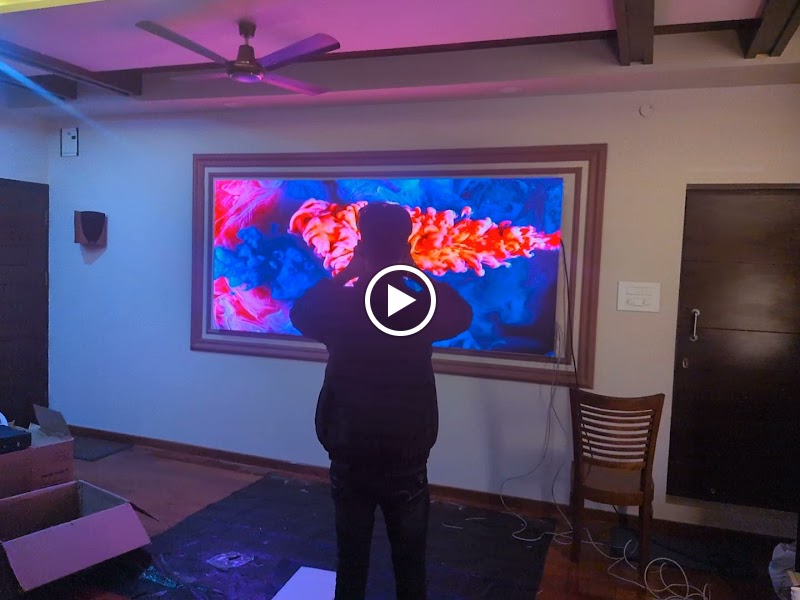
PixelSpot builds LED video walls in its own Bengaluru factory and installs them with its own crew, and a fair share of the enquiries we get from Koramangala, Indiranagar, Church Street and Brigade Road are not for a menu wall at all. They come from pub and sports-bar owners who want the match on one seamless screen the whole room can see, instead of a projector that washes out when the lights come up and a cluster of TVs with bezels running through the pitch. This page is for that buyer. It covers what makes a bar screen different from a restaurant screen, the spec decisions that matter on a match night, what a wall costs in 2026 at our published rates, and how the job runs in a venue that cannot shut for a week.
Why a pub screen is a different problem from a restaurant screen
A restaurant menu wall is glanced at for a few seconds from a queue two or three metres away. A pub screen is watched for ninety minutes of football, four hours of an IPL double-header or a full Sunday of Formula 1, by people standing three deep at the counter and sitting at the far end of a long, dim room. Four things change:
- Footfall on match nights. An RCB home game at the Chinnaswamy, a Premier League weekend or an F1 race is when the bar is full and the bill is highest, so the screen has to work hardest exactly when the room is loudest and darkest.
- More than one feed. IPL and a Premier League fixture regularly overlap on the same evening. A bar needs to show both, or switch between them in seconds, without a staff member fumbling with three remotes.
- Sound has to match the picture. A crowd reacts to the roar, and if the audio runs ahead of or behind the shot on screen the reaction falls flat. Audio sync is a real commissioning step, not an afterthought.
- Late-night ambience. A screen bright enough to beat afternoon sun on a terrace is a floodlight at 11 pm in a dim bar. Dimming on a schedule is part of the design.
If what you need is a scheduled menu board or a promotional wall for a cafe, the restaurant and cafe page covers that buyer, and the hotel page covers lobbies and banquet halls. This page is about screening.
LED wall vs a projector vs a bank of TVs for a bar
| Option | With bar lighting on | Seams | Size for a 12 m room | Daily-use life |
|---|---|---|---|---|
| Projector | Washes out; needs a near-dark room | None | Fills the wall, but dim | Lamp or laser source and filters need replacing; consumer units are not rated for 12-hour days |
| Bank of 55-inch TVs | Bright enough | Bezels cut through the pitch and the score bar | Four TVs is still small from the back of the room | Consumer panels; each one fails on its own schedule |
| Indoor LED wall | 800 to 1,200 nits; runs at 30 to 40% and still wins | None | Any size, 10×6 ft to 16×9 ft and beyond | 8 to 12 years, with modules and power supplies serviced in place |
The honest summary: a projector is the cheapest way to fill a wall in a room you can black out, a TV bank is fine for a small bar with the screen close to the seats, and an LED wall is the only option that gives a big, seamless, bright picture with the lights on. The longer comparisons are on LED wall vs projector and LED vs LCD video wall.
The spec decisions that matter in a bar
Pixel pitch and viewing distance in a long bar
The rule of thumb is that the pitch in millimetres is roughly the closest comfortable viewing distance in metres: P2.5 looks sharp from 2.5 m, P3 from 3 m, P4 from 4 m. In a bar the nearest viewer decides the pitch, not the farthest. If the screen sits above the back bar and the first stools are 2.5 to 3 m away, P2.5 is right; go coarser and the batter's face from the closest seat turns into a grid. If the wall is at the end of the room and nobody sits within 4 m of it, P3 or P4 saves money with no visible loss.
Size is decided by the farthest seat. A 10×6 ft wall reads comfortably to about 10 to 12 m, a 12×8 ft wall to 15 m, and a 16×9 ft wall to 18 to 20 m. Long, narrow Bengaluru pubs converted from old bungalows often have a 14 to 16 m throw from the door to the back wall; for those a 12×8 ft P2.5 wall is the usual answer. Run your own numbers on the viewing distance calculator and we will confirm them on the site survey.
Brightness and dimming for late-night ambience
PixelSpot indoor panels are rated 800 to 1,200 nits. A bar never needs all of it: with the lights on at 7 pm a wall runs at about 40%, and after 10 pm most venues settle at 20 to 30% so the screen sits in the room instead of dominating it. PixelOS schedules the dimming curve by the hour, and an ambient-light sensor can take over so the wall follows the dimmer switch. Running low also roughly halves the heat in the modules, which is the single biggest factor in how long the wall lasts. Terrace and rooftop bars are different: a screen that has to be watched in afternoon sun needs outdoor panels at 5,000 nits or more, with auto-dimming down to a few hundred nits after dark.
IP rating and cabinet type
An indoor bar wall uses die-cast aluminium cabinets with front-serviceable modules, because the wall goes flush against a back wall or into a recess with no rear access; a technician swaps a module from the front in minutes without pulling the wall apart. Indoor cabinets are not sealed, and that matters in a bar: spilled drinks, smoke machines, a kitchen pass nearby and monsoon humidity all shorten the life of unsealed electronics, so we keep the bottom edge of the wall above splash height and put the processor in a dust-filtered enclosure. A covered terrace, a rooftop or an open-front bar on Church Street needs IP65 outdoor cabinets, front and back, exactly as we fitted at Acai Theory on 100 Feet Road. Ask for a refresh rate of 3,840 Hz or higher: guests film the screen for Instagram on every big night, and a low-refresh wall shows rolling bands on their phones.
Multi-feed match day: HDMI switching and split screens
A bar wall is only as good as what feeds it. The usual sources are a commercial DTH set-top box or two, a streaming device for fixtures that are only on OTT, a laptop for the DJ or quiz visuals, and a scoreboard or ticker feed. All of these go into a video processor with two to four HDMI inputs that sits between the sources and the wall. The processor holds presets: one match full-screen; two matches side by side when IPL and the Premier League overlap; a main match with a second in a picture-in-picture window; and a Sunday F1 layout with timing graphics down one side. A bartender switches presets from a small button panel behind the counter or from a phone, not from a laptop in the back office. We wire and label every input on handover so the Saturday staff can run it without calling us.
Audio sync
An LED wall has no speakers, so sound comes from the same set-top box or streaming device that feeds the picture, through an HDMI audio extractor or the processor's audio output, into the bar's existing amplifier or DSP. Scaling and switching add a frame or two of video delay, so the sound arrives fractionally before the picture and a goal celebration looks slightly wrong. The fix is a 40 to 80 ms audio delay dialled into the DSP or a small delay unit, set once during commissioning while watching a live feed. We do this on every bar installation. When the sound is off for a quieter dinner crowd, the processor keeps the broadcast score bug and captions on screen.
Screening licence note
Showing live sport to paying customers is not the same as watching it at home. Broadcasters and DTH operators sell commercial-establishment subscriptions for pubs and bars, and screening on a residential pack is a breach of their terms that can cost you the feed mid-season. PixelSpot supplies the screen, the processor and the wiring; the venue holds the commercial viewing subscription and the music licence for whatever plays through the same speakers. Sort the subscription before the season starts, not on match day. We are not lawyers, so confirm the current rules with your broadcaster and your licensing consultant.
What an LED screen for a pub costs in Bengaluru (2026)
PixelSpot's published rate for indoor P2.5 is from ₹5,500 per sq ft installed, so a 10×6 ft match wall starts at ₹3.3 lakh before GST, a 12×8 ft wall at ₹5.3 lakh and a 16×9 ft wall at ₹7.9 lakh. Outdoor panels for a terrace start at ₹5,000 per sq ft plus the support structure. Every figure includes panels, cabinets, controller, power supplies, cabling, installation by our own crew, PixelOS, 5% spare modules and the 2-year pixel-to-pixel onsite warranty.
| Bar layout | Suggested wall | Pitch | From (before GST) |
|---|---|---|---|
| Small pub, farthest table 6 to 8 m | 8×4 ft | P2.5 indoor | ₹1.8 lakh |
| Typical sports bar, 10 to 12 m room | 10×6 ft | P2.5 indoor | ₹3.3 lakh |
| Brewery hall or long bungalow bar, 14 to 16 m | 12×8 ft | P2.5 indoor | ₹5.3 lakh |
| Large taproom or mezzanine venue, 18 m and beyond | 16×9 ft | P2.5 indoor | ₹7.9 lakh |
| Covered terrace or rooftop | 10×6 ft | P3 outdoor, IP65 | ₹3 lakh plus structure |
Budget separately for the parts that make it a bar wall rather than a display: a multi-input video processor with split-screen presets is typically ₹40,000 to ₹1.2 lakh depending on the number of inputs and whether you need picture-in-picture; audio integration with a delay unit is a small line item if the bar already has an amplifier and DSP; and a dedicated 20 A line, because a 10×6 ft indoor wall peaks at about 3.9 kW on a full-white frame even though it averages about 1.1 kW on match content (details on the power consumption page). GST is 18% on top, with input credit for registered businesses. The price guide lists every pitch and size, the 10×6 ft page breaks down the most common bar wall, and the configurator gives an exact figure for your room in a minute.
Whether it pays back is arithmetic you can do from your own till: extra covers on a match night multiplied by average spend, multiplied by the number of IPL, Premier League, F1 and ICC evenings in a year, against the cost of the wall. We will not invent a number for you. Do that sum before you pick a size.
Installing in a working bar in Bengaluru
- Free site survey. We measure the wall, check sightlines from the closest stool and the farthest booth, meter the ambient light at opening time and at midnight, and check the power and where the processor and sources will live. You get a 3D mockup of the wall in your room.
- Fixed quote with pitch, size, processor inputs, audio integration and warranty spelled out line by line.
- Delivery in 10 to 15 working days. Panels are assembled and burn-in tested at our Bengaluru factory. If you want the wall up before the IPL season opens in late March, place the order by early March.
- Installation in closed hours. Frame, panels, processor and audio delay are fitted and commissioned by our own crew, usually overnight or across two mornings, so the bar never loses a trading evening. We never subcontract installation.
- Handover with the bar staff, not just the owner: preset buttons, PixelOS scheduling and what to do if a source drops out.
After that, PixelOS monitors the wall and reports a failed power supply or module to us before your staff notice. Service is within 24 hours anywhere in Bengaluru with spares in the van, which is what you want on a Saturday morning before a 7.30 pm kick-off; the repair and AMC page has the response times and costs. Outside the city, PixelSpot installs and services pub and bar walls in every Karnataka district, including Mysuru, Mangaluru, Hubballi and Belagavi, plus Hosur and Krishnagiri just across the Tamil Nadu border at 40 to 90 km from our factory; the Karnataka page explains how surveys and service visits are scheduled there, and the Bangalore page covers the city itself.
Proof from PixelSpot walls in Bengaluru
None of our three published case studies is a bar, but each one shares a piece of the bar problem:
- Acai Theory, Indiranagar: an outdoor P2.5 IP65 wall in a shopfront that faces afternoon sun, with auto-dimming so it is legible at 3 pm and comfortable at 10 pm, front-service modules because there is no rear access, and PixelOS on the owner's phone. That is the spec for a terrace or open-front bar.
- Corporate office cafeteria wall: an indoor wall that replaced a projector washing out under skylights, fed by HDMI from a room PC with PixelOS running an idle screen when nothing is presenting. Swap the PC for a set-top box and the idle screen for tonight's fixtures and you have a sports bar.
- Amukti store entrance display: a portrait screen built into a mall entrance pillar to pull people in from a crowded corridor. The same idea works at a pub's street door as a teaser for the evening's match and the happy-hour deal.
Content between matches
The wall earns its keep on the other five nights too. PixelOS schedules a tap list for a brewery, happy-hour pricing that changes at 7 pm, the week's fixture list, quiz-night slides, DJ visuals from the laptop input and paid slots for a beer or spirits brand partner, all from a phone, with the match preset one button away when kick-off arrives. No technician is needed to change a video.
Get an exact quote: WhatsApp the room dimensions, the distance to the farthest seat and a photo of the wall to +91 72048 08334, or use the 60-second configurator. Site survey and 3D mockup are free across Bengaluru.
Need Help Choosing the Right LED Display?
Get a free consultation and instant quote from PixelSpot experts.
Get Free Quote →