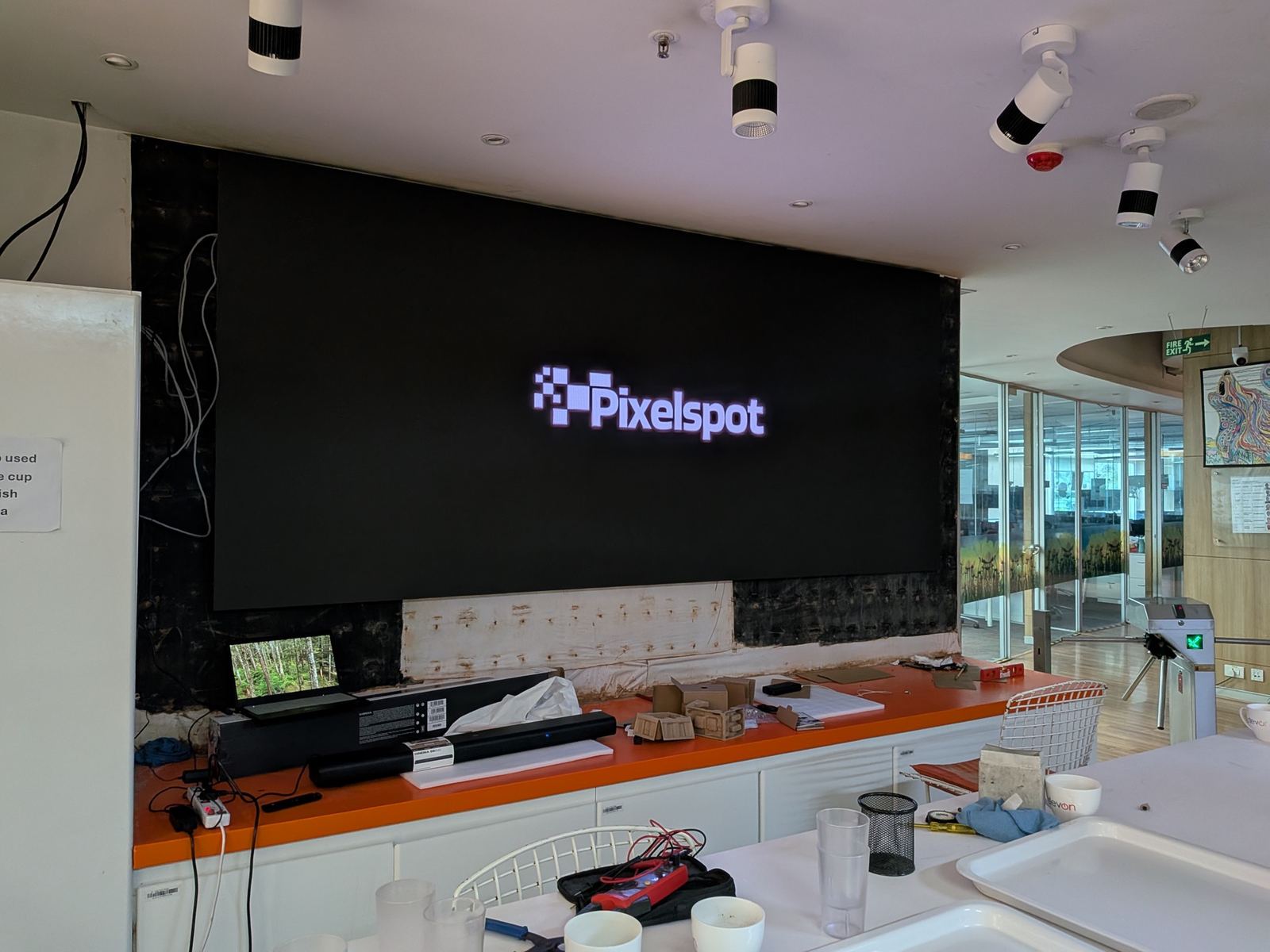
"Video wall" is the phrase facilities managers, AV consultants and IT procurement teams in Bengaluru put on a tender. It rarely says which technology they mean. This page is for that buyer: what a video wall is in 2026, when LED tiles beat LCD tiles and when they do not, the specification lines that decide whether a boardroom, NOC or lobby wall works, a realistic price band from PixelSpot's published per-square-foot rates, and what installation looks like inside a tech park. PixelSpot manufactures LED video walls at its own factory in Bengaluru and has done since 2022; where an LCD wall is the honest answer, we say so.
What "video wall" means on a Bengaluru tender
Two families of product answer to the name. An LCD video wall tiles commercial 46, 49 or 55 inch panels with narrow bezels, typically 0.44 to 3.5 mm, daisy-chained by DisplayPort loop-through and driven by a matrix processor. An LED video wall tiles LED modules onto cabinets, so the surface is seamless and can be any size or aspect ratio. Older AV bills of quantities still write "video wall" and mean LCD out of habit; newer ones write "direct-view LED" or "dvLED" for the seamless kind. Ask the specifier which they mean before comparing quotes, because a 3x3 LCD grid and a 10x6 ft P2.5 LED wall can carry the same line item and differ by a lakh or more.
The short rule we give Bengaluru buyers: if the wall is larger than about 4 sq m, is viewed from 2.5 m or further, sits near glass, or will ever be filmed, LED wins on both looks and seven-year cost. If operators sit under 1.5 m reading small text all day, LCD or a P1.2 LED wall are the two honest choices. The full side-by-side is in our LED wall vs LCD video wall comparison.
Where video walls go in Bengaluru, and what each one needs
Most of the video walls we build in the city go into the tech corridors: Outer Ring Road campuses between Marathahalli and Bellandur, Whitefield and ITPL, Electronic City, Manyata Tech Park in Hebbal, and the global capability centres and startups spread across Koramangala, HSR Layout and Indiranagar. The room decides the specification.
| Room | Typical size | Pitch | Brightness | Source and control |
|---|---|---|---|---|
| Boardroom, Teams or Zoom room | 9.5x5.3 ft to 11.3x6.4 ft | P1.5 to P1.8 | 600 to 800 nits, run at 40% | Room PC over HDMI, EDID set to native |
| NOC, SOC, command centre | 16x6 ft to 24x8 ft | P1.2 to P1.5 | 500 to 700 nits, dimmed for shift work | Multi-window processor, 8 to 16 feeds, saved layouts |
| Reception and lobby | 10x6 ft to 12x8 ft | P1.8 to P2.5 | 800 to 1,200 nits if there is glass frontage | PixelOS scheduled brand content |
| Cafeteria and town hall | 12x7 ft to 16x9 ft | P2.5 | 600 to 800 nits | HDMI from stage plus PixelOS idle screen |
| Experience centre, showroom | 12x7 ft to 20x10 ft | P1.8 to P2.5 | 800 to 1,000 nits | Media server or PixelOS playlists |
| Storefront facing daylight | 8x4 ft to 12x6 ft | P2.5 to P4 outdoor | 4,500 to 6,500 nits, IP65, auto-dimming | PixelOS from a phone |
Two of those rows come straight from projects on this site. The corporate office cafeteria wall replaced a projector that washed out under skylights and a row of TVs with bezels across every slide; it now runs town halls with the blinds open and carries announcements between meetings. The Acai Theory shopfront in Indiranagar is the daylight row: outdoor P2.5, IP65, auto-dimming from 3 pm sun to 10 pm street, menu changed from the owner's phone.
The specification lines that actually matter
Pixel pitch and native resolution
Pitch is the distance between LED centres in millimetres, and it sets the pixel count of a given wall: width in mm divided by pitch. A 10x6 ft wall (3,048 by 1,829 mm) is 1,219 by 731 pixels at P2.5, 1,693 by 1,016 at P1.8, 2,032 by 1,219 at P1.5 and 2,540 by 1,524 at P1.2. That matters for offices because laptops output 1920 by 1080. The footprints that show Full HD pixel-for-pixel, with no scaling, are 9.45 by 5.3 ft at P1.5, 11.3 by 6.4 ft at P1.8 and 15.7 by 8.9 ft at P2.5. Choose the pitch from the nearest seat: distance in metres roughly equals the comfortable pitch in mm, and halve that for spreadsheets and dashboards. Our pixel pitch guide and viewing distance calculator do the arithmetic for your room.
Brightness in nits
Indoor fine-pitch modules are rated 600 to 1,000 nits and should run at 30 to 50 percent, which keeps them comfortable under office lighting and doubles the years before dimming. A lobby with a glass frontage on the sunny side wants 1,000 to 1,500 nit modules so the wall is not washed out at noon. Anything that faces the street needs outdoor modules at 4,500 to 6,500 nits with an ambient light sensor, otherwise the wall is blinding after dark. More on this in how many nits an LED wall needs.
IP rating and cabinet type
IP20 or IP30 cabinets are correct indoors; IP65 front and IP54 rear for anything rained on. For office and lobby walls we use die-cast aluminium cabinets with magnetic front-service modules, because the wall almost always sits flush against drywall or a recess with no rear access. Cabinet depth of 80 to 100 mm lets the wall sit inside a false wall with a trim; 16:9 walls are built from 640 by 480 mm modules so the aspect ratio comes out right without a filler strip. Ask for the flatness and seam figure in writing, under 0.5 mm, because a wavy seam is the first thing a client notices on a boardroom wall. Curved cabinets with plus or minus 10 degree adjustment cover concave lobby walls.
Refresh rate, greyscale and viewing angle
If the wall will be on camera, at a streamed town hall or behind a presenter on a video call, specify a 3,840 Hz refresh rate; 1,920 Hz panels show scan lines on phones and webcams. Fourteen to sixteen bit greyscale keeps dark video from banding. A 160 degree horizontal viewing angle covers seats at the sides of a wide boardroom. At P1.2 and below, COB (chip on board) modules resist knocked-off LEDs at touch distance in lobbies; SMD modules are fine from P1.5 upward and cheaper.
Processor, controller and splicing
Every LED wall has a sending card that maps pixels to cabinets over Gigabit Ethernet; a common rule of thumb is about 6.5 lakh pixels per network port, so a 10x6 ft P2.5 wall runs on one port and a 16x6 ft P1.5 wall needs four or five. A basic sending card shows one HDMI source scaled to the wall. A video processor in front of it adds what corporate buyers actually want: HDMI 2.0, DisplayPort and 3G-SDI inputs, picture-in-picture, multi-window layouts, splicing one 4K source across the canvas, and presets an NOC operator recalls with one button. HDCP handling matters for laptops playing protected content, and the EDID should be set to the wall's native pixel count so Windows does not scale the desktop. Upstream, a KVM or matrix switcher feeds the processor; downstream, PixelOS, our cloud CMS, fills the wall with scheduled content whenever no meeting is running. We build on NovaStar, Colorlight and Huidu hardware and stock spares for all three in Bengaluru.
24x7 duty cycle
An NOC wall never switches off, and that changes the bill of materials rather than the panel choice. Specify dual or N+1 power supplies per cabinet, loop-back data cabling so one failed cable does not black out a column, an online UPS or at least a stabiliser on the wall's circuit, ventilation behind a recessed wall, and 5 percent spare modules from the same batch, which PixelSpot ships with every wall. Run at 30 to 50 percent brightness, an LED wall in that duty lasts 8 to 12 years; an LCD grid's backlights typically fade within 5 to 7. The full wear list is in our LED wall lifespan guide.
What a video wall costs in Bangalore in 2026
PixelSpot publishes per-square-foot rates, so a budget number takes a minute. Indoor P2.5 is ₹5,500 to ₹8,000 per sq ft, P2.0 is ₹8,000 to ₹12,000, P1.5 is ₹12,000 to ₹18,000 and P1.2 is ₹18,000 to ₹25,000; outdoor P4 starts at ₹5,000. Applied to the rooms above:
| Configuration | Area | Per sq ft | Wall estimate, before GST |
|---|---|---|---|
| Lobby, 10x6 ft, P2.5 | 60 sq ft | ₹5,500 to ₹8,000 | ₹3.3 to ₹4.8 lakh |
| Cafeteria, 12x8 ft, P2.5 | 96 sq ft | ₹5,500 to ₹8,000 | ₹5.3 to ₹7.7 lakh |
| Boardroom, 11.3x6.4 ft, P1.8, native Full HD | 72 sq ft | ₹7,000 to ₹12,000 | ₹5 to ₹8.6 lakh |
| Boardroom, 9.5x5.3 ft, P1.5, native Full HD | 50 sq ft | ₹12,000 to ₹18,000 | ₹6 to ₹9 lakh |
| NOC, 16x6 ft, P1.5 | 96 sq ft | ₹12,000 to ₹18,000 | ₹11.5 to ₹17.3 lakh |
| NOC, 16x6 ft, P1.2 | 96 sq ft | ₹18,000 to ₹25,000 | ₹17.3 to ₹24 lakh |
| Storefront, 10x6 ft, P4 outdoor IP65 | 60 sq ft | ₹5,000 to ₹8,000 | ₹3 to ₹4.8 lakh |
Included at those rates: modules, cabinets, receiving cards, power supplies, sending card, mounting frame, cabling, installation, calibration, 5 percent spares, PixelOS and the 2-year pixel-to-pixel onsite warranty. Added when needed: GST at 18 percent, a multi-window video processor once you have more than two sources, a UPS, structural steel or civil work for a facade, and false-ceiling rework for the cable route. An equivalent 3x3 LCD wall of 55 inch panels lands at ₹4.5 to ₹7 lakh installed, which is why LED now wins the lobby and cafeteria rows outright. Full tables by size and pitch are on the LED wall price page; the configurator gives your exact wall a number in 60 seconds, and HSN code and GST treatment is covered separately for the purchase order.
Installation reality in Bengaluru offices, tech parks and malls
- Free site survey. We measure the recess, check whether the wall is RCC, drywall or glass, trace a cable route to the AV rack, and confirm power. A 10x6 ft P2.5 wall averages about 1.1 kW and peaks near three times that on a white frame, so it needs its own 16 A or 32 A circuit with a proper earth. We also take the seating plan, because the nearest chair sets the pitch.
- 3D mockup in your room. You see the wall in the actual boardroom or lobby before signing, including the trim and how the frame meets the false ceiling.
- Factory build and burn-in. Cabinets are assembled and burn-in tested at our Bengaluru facility so dead pixels and weak power supplies show up in the factory, not on your handover day.
- Install slot. Tech parks on Outer Ring Road, Whitefield and Electronic City need a work permit, a goods-lift booking and usually an after-hours or weekend slot; malls open their loading docks before trading hours. A 10x6 ft indoor wall is installed and calibrated in one working day; NOC walls take two to three. The Amukti store display went into an entrance pillar before mall opening with content already loaded, the processor tucked in the back office.
- Calibration and handover. Colour and brightness calibration across every cabinet, EDID set to native resolution, a test call on the room PC, and PixelOS training for whoever owns the idle content.
After handover, service is the reason to buy locally. PixelSpot's own engineers reach any Bengaluru site within 24 hours, usually the same day, with NovaStar, Colorlight and Huidu spares in the van; PixelOS Signal reads most controller faults remotely before anyone drives. The 2-year pixel-to-pixel onsite warranty covers every module, card and power supply; after it, an AMC from about ₹150 per sq ft per year keeps priority response and calibration. Details are on our repair and AMC page, and the wider city picture is on LED wall in Bangalore.
The same crew covers every Karnataka district, including Mysuru, Mangaluru, Hubballi-Dharwad, Belagavi, Kalaburagi, Shivamogga and Tumakuru, at identical panel pricing, plus Hosur and Krishnagiri just over the Tamil Nadu border at 40 to 90 km from the factory. Outside Bengaluru, service calls are scheduled within the week. We do not install beyond Karnataka and those two border towns.
LCD or LED: the one-minute decision
- Choose LED for lobbies, cafeterias, showrooms, auditoriums, any wall over 4 sq m, any wall near glass or outdoors, any wall that will be photographed, and any shape that is not a multiple of 55 inch panels.
- Choose P1.2 to P1.5 LED for boardrooms and NOCs where the nearest operator is 1 to 2 m away and the budget allows ₹12,000 per sq ft or more.
- Choose LCD only for a small operator desk wall under 4 sq m where people read 10 point text at arm's length all day, or where touch overlay is mandatory.
- Either way, insist on the processor spec, the refresh rate, a written seam and flatness figure, a warranty that names onsite response time, and a vendor whose factory and crew are in Karnataka.
Get an exact quote: WhatsApp the room size, nearest seating distance and the sources you need to show to +91 72048 08334, or use the 60-second configurator. Site survey and 3D mockup are free across Bengaluru.
Need Help Choosing the Right LED Display?
Get a free consultation and instant quote from PixelSpot experts.
Get Free Quote →